10. Accounts, risk, fees, market data, drop copy, surveillance
Draft 0.2, 2026-11-13. Normative base: 01-conventions.md, especially §12
and the binding decisions of §14 (two-pass lanes, deadline admission, sessions across epochs,
dedicated and pooled lanes of §14.15, the core map of §10).
This chapter defines who trades (accounts), with what (balances and per-book allocations), under
which limits (pre-trade risk in the lane), how a fill moves money (settlement), what it costs
(fees), and what the world sees afterwards (market data, drop copy, surveillance, statements).
The matching itself is 05-engine.md. The session protocol and its rate buckets are
04-protocol.md. The log and finality are 07-replication.md.
0. Scope, constraints and number labels#
- Every risk check and every settlement runs on a lane core, inside
LANE_NS_PER_MSG. Risk and reservation run in pass 1 of the lane (01 §14.2), in index order, insideLANE_PASS1_NS(5 ns per message). No risk state lives on the BBO core. On a dedicated lane no risk check crosses cores. In the pool (01 §14.15) a check crosses cores only inside CCD 7, under the account's token (§1.2). - The 1 µs is a maximum for every accepted packet (01 §14.0). Nothing in this chapter has a
percentile on the request path. A packet that would miss is answered
BUSY(01 §14.1), andBUSYleaves no trace in risk state: no reservation, no rate token, no fee (§3.11). - Market data, drop copy, surveillance and statements run on replica-class boxes, never on the sequencer. They are deterministic functions of the finalized log, so any replica can regenerate them byte for byte.
C-UNIX: every process here runs on Linux in production and on macOS undervyrn-sim.C-NOCHIP: market data is encoded on general-purpose cores and replicated by merchant switches; no FPGA feed handler, programmable switch or SmartNIC logic.C-COTS: market-data taps are passive optical splitters; NICs are those of 01 §10.C-ONEBIN:vyrn-mdandvyrn-dropcopyare the same binaries everywhere; only the distribution backend (multicast or unicast) changes.- Numbers are budget, measured or vendor (00). Risk limits and fee rates are config values with a default (Requests to 01, item 1).
1. Accounts#
1.1 Account model#
| Kind | Trades | Holds ledger balance | Notes |
|---|---|---|---|
| Standalone | yes | yes | master == self |
| Master | no | yes | Owns sub-accounts; holds the limit envelope and the fee tier |
| Sub-account | yes | yes | master = its master; its own lane, allocations and limit share |
| Venue fee | no | yes | One per book; its book balance is the sum of the lanes' fee_acc (§5.5) |
| Liquidation | v2 only | yes | One per lane per perp book (§6) |
Decisions:
- Every trading account is a leaf. A master never trades. The reason: a master's limits are the envelope that its sub-accounts share, and a trading master would need a share of its own.
AccountId0 is reserved for control ops (§2.4).0xFFFF_FF00..=0xFFFF_FFFFare venue accounts (fee, liquidation, test). Trading accounts use the rest.- A session belongs to one trading account (01 §3). A firm with ten sub-accounts opens ten sessions, at least one per sub-account.
- Accounts are created by a finalized ledger transaction, never on the 1 µs path. Creation assigns a lane for the current epoch (§1.3, rule N), so a new account trades in the epoch it is created.
1.2 Account state in the lane#
The lane holds one AcctRisk per account it owns, indexed by a dense lane-local slot. The session
table maps SessionId → acct_slot, so no lookup by AccountId happens on the hot path. All
records are #[repr(C, align(64))] and are written only by the owning lane (INV-WRITER).
#[repr(C, align(64))]
pub struct AcctRisk {                 // 128 bytes: 2 cache lines on x86, 1 on Apple M
    // line 0: read on every New
    pub state: AcctState,             // u8: Active | Killed | Closed
    pub stp_mode: u8,                 // account default STP mode, 01 §6.2 bits 4–5 values
    pub stp_tag: u16,                 // 0 = no STP; else the master's tag for this epoch (§3.6)
    pub _rsv0: u32,
    pub max_open_orders: u32,         // config, default 10_000, hard max RSK_MAX_OPEN_HARD
    pub max_order_qty: Qty,           // config, default Qty::MAX
    pub max_notional: u64,            // quote units per order, config; ≤ RSK_NOTIONAL_HARD_MAX
    pub fee_mul: u64,                 // ceil(max_fee_ppm × 2^64 / RSK_FEE_DENOM) (§3.2)
    pub msg_fee_improve: u32,         // quote units per improve (§5.3)
    pub msg_fee_cross: u32,           // quote units per cross (§5.3)
    pub new_bucket: Bucket,           // 16 B: new-order bucket (§3.8)
    pub _pad0: [u8; 8],
    // line 1: read on crosses, fills and timers
    pub cross_bucket: Bucket,         // 16 B
    pub maker_ppm: i32,               // negative = rebate
    pub taker_ppm: i32,
    pub auction_ppm: i32,
    pub master: AccountId,
    pub account: AccountId,
    pub cod_timeout_ns: u32,          // cancel-on-disconnect, 0 = off (§3.7)
    pub book_mask: u8,                // which book slots of the group this account may trade
    pub _pad: [u8; 23],
}

#[repr(C, align(64))]
pub struct BookBal {                  // 64 bytes per (account, book slot)
    pub quote_free: QuoteAmt,         // u128
    pub quote_resv: QuoteAmt,         // u128
    pub base_free: BaseLots,          // u64
    pub base_resv: BaseLots,          // u64
    pub open_orders: u32,             // live orders of this account in this book
    pub _pad: [u8; 12],
}
Budget: ACC_MAX_ACCOUNTS_PER_LANE = 65_536, so AcctRisk takes 8 MB per lane and BookBal
4 MB per lane per book. That does not fit in cache, so the request path never touches it cold.
Only an account with an open session can send a packet, and a lane serves at most
MAX_SESSIONS_PER_LANE = 4_096 sessions. So at an account's first session open the lane moves its
records into one of ACC_HOT_SLOTS = 4_096 slots at the front of the arrays, and back at its last
close (logged ops, 04, so the move replays): 768 KB per lane for one book. The hot region is
pinned in the CCD's L3 with Linux resctrl cache allocation (COTS, C-NOCHIP; the up to eight
dedicated lanes of a CCD use ≤ 6.3 MB of 32 MB), and prefetched when the lane reads the packet
header. The worst case is an L3 hit (vendor: Zen 5 ~10 ns), hidden behind the per-packet SipHash
(§3.10). Accounts with no open session are touched only by settlement at a boundary (§4.2), where
no response waits on a miss.
Pooled accounts (01 §14.15). The pool's accounts have one shared AcctRisk/BookBal region
for the whole pool (lanes 42–48, cores 56–62 on REF, 01 §10), pinned in CCD 7's L3: 7 × 4_096
hot slots, 5.4 MB. Each hot slot has a PoolTok line (64 B): holder: LaneId, last: LaneSeq.
A pool core that dequeues a packet, its own or one it stole (05), takes the account's token with
one CAS inside the CCD (~20 ns, budget) after the deadline test and before pass 1. It keeps the
token while its queue holds more of that account's packets, and releases it with a release store
after pass 2. The holder is the only writer of the account's records (INV-WRITER per field,
with one logical owner at a time). Session order holds because the holder checks the session's
next expected pkt_seq before pass 1 (04). A cancel of an order that rests in a sibling's
Segment16 clears its bit with an atomic fetch_and, and the holder releases the reservation at
the ack. Replay needs the cross-core order of an account's packets, so each token take is logged
as AcctTake { account, ver, lane } (01 §14.17 item 4): ver counts the account's takes, and
replay applies the account's work in ver order on the logged lane. A packet shed at dequeue
takes no token and logs no AcctTake (§3.11).
1.3 Lane assignment: lane_map#
lane_map: AccountId → (LaneClass, LaneId) is part of each epoch's configuration. It changes only
at an epoch boundary, and so does an account's class. The reason: a lane owns an account's resting
orders and balances. Moving them mid-epoch is a cross-core state transfer on the hot path. At an
epoch boundary the new sequencer loads all state from the handoff anyway, so a move is free there.
The map gives each account a class (01 §14.15 item 4):
Dedicated: theLaneIdis one of then_deddedicated lanes (0–41 onREF). The lane serves the accounts of one firm (a master and its sub-accounts, or one standalone account) and nobody else. The top firms by load, which message volume dominates, hold these lanes.Pooled: every other account. TheLaneIdis the account's pool queue (42–48 onREF). It only steers RX, because any pool core can serve the packet (01 §14.15).
The map publishes both fields, so each client knows its class and its BUSY bound (02 REQ-LAT-5, 01 §14.17 item 2).
Who computes it. Every replica computes lane_map(e+1) from the finalized log, by the
algorithm below, during epoch e. The result is deterministic, so all replicas agree on its hash.
The hash goes into the epoch configuration record that 08 certifies (Requests to 01, item 4). The
sequencer never computes it, so a sequencer cannot place a victim in a slow lane.
Load metric. The cost of an account to its lane is measured from the log, not from the live box's clocks:
lane_ns(a, s) = LANE_NS_PER_MSG × msgs(a, s) + RSK_SETTLE_NS × fill_events(a, s)
load(a)       = the 99th percentile over seconds s of lane_ns(a, s), over the last
                ACC_LOAD_WINDOW_EPOCHS epochs that ran in the same home
msgs(a, s) counts every message of a's sessions in second s of order-stream time (rx_ts).
fill_events(a, s) counts fill events delivered to a's lane for a's orders. The metric uses
the same home's past epochs, because an account's activity follows its own trading hours. The
percentile uses the integer rule of §9.1.
Algorithm (deterministic, integer only). One lane's capacity is CAP = 10^9 ns/s. The
target is ACC_LANE_TARGET_PPM = 500_000 (budget, 50% of a lane), so bursts do not queue. A
firm's load f[m] is the sum of load(a) over its accounts.
Moves are minimized, because a move closes sessions. Sessions survive epoch boundaries (01 §14.8); only an account that changes lane has its sessions closed, and a change of class is a change of lane for every account of the firm. So the algorithm minimizes moved accounts, not load spread:
- Promotion and demotion only at a boundary, with hysteresis. A free dedicated lane goes to
the largest pooled firm. When no lane is free, a pooled firm replaces the smallest dedicated
firms only if it is larger than each of them by
ACC_PROMOTE_RATIO_PPM = 1_250_000(config, 1.25×), and no firm involved changed class in the lastACC_MOVE_COOLDOWN_EPOCHS = 3epochs of the same home. So two firms of similar size never swap back and forth. - Inside a class, almost nothing moves. A dedicated firm keeps its lane ids. Only a firm that
holds several dedicated lanes rebalances its own accounts, and only on a lane over
ACC_LANE_TRIGGER_PPM = 550_000(budget; the gap to the target is hysteresis), largest account first. A pooled account keeps its pool queue for as long as it stays pooled, because stealing (01 §14.15) already spreads the pool's load.
fn next_lane_map(prev: &LaneMap, load: &[(AccountId, u64)], cm: &CoreMap) -> LaneMap {
    let (nd, np) = (cm.n_ded, cm.n_pool);                     // REF: 42 and 7 (01 §10)
    let target = CAP * ACC_LANE_TARGET_PPM / 1_000_000;
    // Rule K (keep): start from the previous map; drop accounts that no longer exist. A firm on
    // a dedicated lane id ≥ nd, or an account on a pool queue outside the pool, is unplaced.
    let mut map = prev.retain_existing().unplace_outside(nd, np);
    let f = firm_loads(&map, load);                            // Σ load(a) per firm
    let mut moves = 0;
    // Rule C (class). Pooled firms in descending load (ties: lower master AccountId).
    for p in map.pooled_firms_desc(&f) {
        let need = ceil_div(f[p], target).max(1);              // dedicated lanes p needs
        let short = need.saturating_sub(map.free_dedicated(nd));
        let ds = map.smallest_dedicated(&f, short);            // fewest small firms freeing `short`
        if ds.lanes() < short { continue; }
        let ok = !cooled(p) && ds.iter().all(|&d| !cooled(d)
                     && f[p] * 1_000_000 > f[d] * ACC_PROMOTE_RATIO_PPM);
        if !ok { continue; }
        let cost = map.accounts(p) + ds.iter().map(|&d| map.accounts(d)).sum::<u32>();
        if moves + cost > ACC_MAX_MOVES_PER_EPOCH { break; }
        for d in ds { map.demote_to_pool(d, np); }             // d's accounts: argmin pool queue
        map.promote(p, need); moves += cost;                   // lowest free lane ids
    }
    // Rule M (move): inside each firm with several dedicated lanes, drain every lane over the
    // trigger to the target into the firm's least loaded lane, largest fitting account first.
    rebalance_within_firms(&mut map, load, &mut moves);
    map
}
// Rule N (new): an account created during epoch e joins its firm's class. In a dedicated firm it
// goes to the firm's least loaded lane; otherwise it goes to the pool queue with the least load,
// from the loads the replicas used for lane_map(e) plus ACC_NEW_ACCOUNT_LOAD per account already
// created this epoch. A new firm is pooled until a boundary promotes it.
Rule K keeps every account in place unless its class changes, its lane is over the trigger, or
its lane no longer exists, so almost every session crosses the boundary untouched.
ACC_MAX_MOVES_PER_EPOCH = 1_024 (config) bounds the state that moves at one handoff and the
sessions closed, class changes included; the epoch report counts promotions, demotions and moves.
Accounts too big for one lane. An account with load(a) > ACC_ACCOUNT_MAX_SHARE_PPM × CAP
(config, 400_000 = 40% of a lane) is flagged MUST_SPLIT in its end-of-epoch statement (§10).
The venue does not split it automatically, because a split divides the firm's capital between
sub-accounts, and that is the firm's decision. Until it splits, its new-order bucket rate is
capped at the 40% share, so it cannot starve the other accounts of its lane or of the pool.
The map depends on the box. lane_map(e+1) is computed for the class sizes of epoch e+1's
home: n_ded dedicated lanes and n_pool pool cores, 42 and 7 on REF (01 §10). The core map
is identical across a replica set, so a failover inside an epoch never changes them. A home with
fewer dedicated lanes demotes the firms of the missing lanes, so operators keep the three homes on
one core map.
A moved account takes its state with it. Balances, reservations and resting orders move with the account. The new sequencer builds every lane from the certified state (08), so a move is a different placement of the same state. Resting-order time priority must survive it (Open questions, item 7).
1.4 Distribution to clients#
A client learns its lane at session open (04): the response carries lane: LaneId, its class,
and the UDP port port_base + lane. On bare metal the NIC steers by destination port, so a packet
sent to the wrong port reaches the wrong lane, which rejects it WRONG_LANE (detail = the correct
lane). A pooled session's packet on any pool port is served, because every pool core serves the
pool; a pooled packet on a dedicated port, or the reverse, is WRONG_LANE. The SDK paces a
dedicated client by LANE_PACE (01 §14.15 item 1), so it never queues behind itself, and puts a
packet's cancels first, where the ack slack is largest (01 §14.17 item 1). On
AWS, ENA steers by RSS, so the response also carries a UDP source port that the published RSS key
and indirection table map to the lane; a packet on the wrong queue is rejected WRONG_LANE too.
There is no forwarding ring: a forward adds a core hop (~100 ns) to a packet still owed 1 µs.
Sessions survive the boundary (01 §14.8, 08): a session keeps its SessionId, lane and port
unless its account moves. lane_map(e+1) is published, signed by the replica quorum, at least
ACC_MAP_PUBLISH_LEAD_S = 3_600 s (config) before the boundary, so a client knows an hour ahead.
At the boundary the handoff closes exactly the sessions of moved accounts; their next packet gets
SESSION_CLOSED with detail RSK_D_MOVED | new_lane (§3.1), and the client opens new sessions to
the new lane. Every other session sends its first packet of epoch e+1 with no re-open.
1.5 Sub-accounts and limit shares#
A market maker that needs more than one lane splits into sub-accounts. Each sub-account is an ordinary trading account with its own allocations and its own share of every limit. All sub-accounts of a master share its class: a dedicated firm's sub-accounts are spread over the firm's own dedicated lanes (Rule M, §1.3), and a pooled firm's sub-accounts are all pooled.
- Limits. The master holds an envelope
L_masterfor each limit (open orders, notional per order, new-order rate, cross rate). Each sub-accountiholdsL_i. The ledger checksΣ L_i ≤ L_masterwhen a share changes. A share changes only by a finalized control op (§2.4,CtlSetLimit), never on the hot path. - Capital. Each sub-account has its own ledger balance and its own per-book allocations. Moving capital between sub-accounts is a ledger transfer, finalized in milliseconds.
- Fee tier. The tier is computed on the master's total volume (§5.2), so splitting never lowers a firm's fees and never raises them.
- STP. All sub-accounts of a master share one
stp_tag(§3.6), so the BBO core prevents a self-trade between two sub-accounts even when they sit in different lanes. - Kill. A master kill reaches every sub-account's lane as one control op per lane (§3.7).
2. Balances and per-book allocations (escrow)#
2.1 Units#
| Quantity | Type | Unit | Range |
|---|---|---|---|
| Base held in a book | BaseLots (u64) |
one lot of the book | 0 … 2^64 − 1 |
| Quote held in a book | QuoteAmt (u128) |
the quote asset's atomic unit | 0 … 2^128 − 1 |
| Order quantity | Qty (u32) |
lots | 1 … max_order_qty |
| Price | Tick (u32) |
ticks | BookSpec.min_tick … max_tick |
tick_size |
u64 | quote units per lot per tick | ≥ 1 |
lot_size |
u64 | base atomic units per lot | ≥ 1 |
The notional of q lots at tick t is q × t × tick_size quote units, exactly. No float and no
division appear in a notional (01 §11).
Decision: all fees are charged in quote. The reason: a buyer then receives exactly q lots,
a seller delivers exactly q lots, base balances stay whole lots, and a sell reserves exactly
qty (01 §12.1).
2.2 The ledger#
The ledger is the replicated record of each account's balance per asset outside every book.
In CHAIN mode it is the chain's custody state (09). In BASE mode it is a replicated state
machine on the same replica sets, finalized by the same Simplex consensus as a book log with no
matching (07). Deposits and withdrawals touch only the ledger. A book never sees a deposit; it sees
an allocation.
An account's capital in a book is its allocation (escrow) for that book. It lives in the
account's lane as a BookBal. Allocated capital is either free or reserved by open orders.
2.3 The allocation state machine#
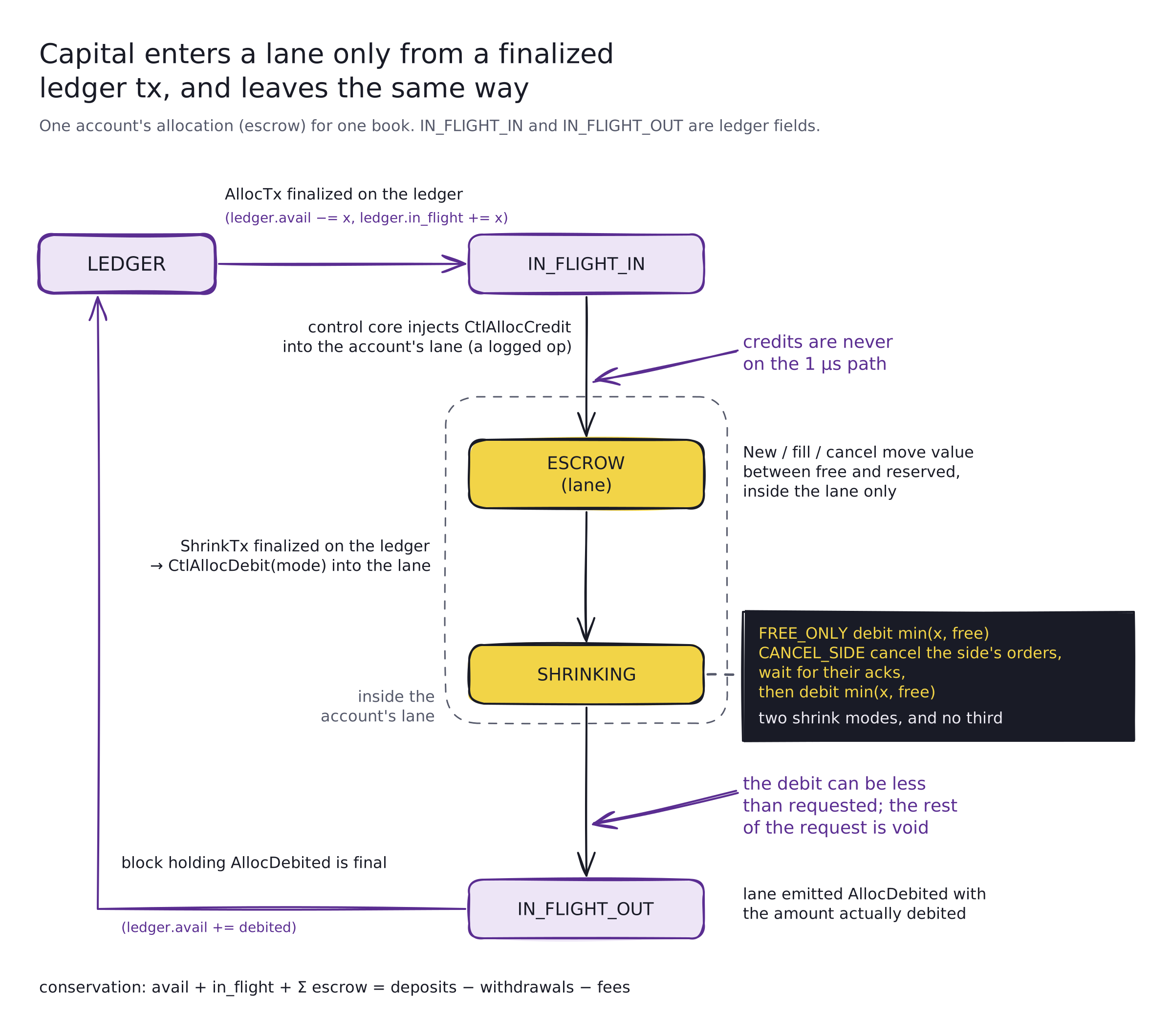
ASCII original
             AllocTx finalized on the ledger
             (ledger.avail −= x, ledger.in_flight += x)
   LEDGER ───────────────────────────────────────────► IN_FLIGHT_IN
     ▲                                                      │ control core injects CtlAllocCredit
     │                                                      │ into the account's lane (a logged op)
     │                                                      ▼
     │                                                 ┌─────────┐ New/fill/cancel move value
     │                                                 │ ESCROW  │ between free and reserved
     │                                                 │ (lane)  │ inside the lane only
     │                                                 └────┬────┘
     │                                                      │ ShrinkTx finalized on the ledger
     │                                                      │ → CtlAllocDebit(mode) into the lane
     │                                                      ▼
     │                                                  SHRINKING ── FREE_ONLY: debit min(x, free)
     │                                                      │      ── CANCEL_SIDE: cancel the side's
     │                                                      │         orders, wait for their acks,
     │                                                      │         then debit min(x, free)
     │                                                      ▼
     │       block holding AllocDebited is final        IN_FLIGHT_OUT  (lane emitted AllocDebited
     └────── (ledger.avail += debited) ◄────────────────  with the amount actually debited)
Rules:
- Credits are never on the 1 µs path. An allocation reaches the lane only after the ledger finalized it. The lane applies it as one control op, in order with the lane's other ops.
- A shrink debits only free balance. Reserved balance backs live orders. Releasing it would let the BBO core fill an order with no money behind it.
- Two shrink modes, and no third.
FREE_ONLY(the default) debits what is free and leaves every order alone.CANCEL_SIDEcancels all of the account's orders in that book on the side that the asset backs (buys for quote, sells for base), then debits. The venue does not choose which orders survive a partial shrink. That choice is a trading decision, and the client makes it with its own cancels before it shrinks. - The debit can be less than requested.
AllocDebitedreports the exact amount, the ledger credits back exactly that, and the rest of the request is void. - Idempotency. Every control op carries the control session's gapless
pkt_seq. The lane applies a control packet once. A replay of the same packet is rejectedBAD_SEQ(04). - Value in flight is counted once.
IN_FLIGHT_INandIN_FLIGHT_OUTare ledger fields. The ledger conservation check isavail + in_flight + Σ escrow = deposits − withdrawals − fees.
2.4 Control ops#
Control ops enter a lane as packets of the reserved control session SessionId = 0 (one per
lane). The control core (core 51 on REF, beside the OS, 01 §10 and §14.17) builds them from finalized
ledger transactions, and from signed admin commands, and pushes them on the lane's control SPSC
ring. A pooled account's control op goes to its pool queue's ring, and the pool core that applies
it holds the account's token (§1.2). The lane processes a control
packet exactly like a client packet: it gets a PacketRecord with a pkt_hash, and its payload is
stored in the data tier (07). Control ops are therefore part of the order stream and replay
exactly.
Deadline admission (01 §14.1) never sheds a control packet: its response goes to the control
core and owes no 1 µs. The lane takes a control packet only when its client RX queues are empty,
or after it has waited RSK_CTL_MAX_WAIT_NS = 100_000 (budget), so control work does not delay
client packets; the order stream records the choice. Each control op is one 16-byte message;
session 0 and codes 0x20…0x2F and 0xA0…0xAF are promoted (01 §14.11).
| Code | Name | 0 | 1 | 2–3 | 4–7 | 8–15 |
|---|---|---|---|---|---|---|
| 0x20 | CtlAllocCredit |
type | asset (0 quote, 1 base) | book | account | amount u64 |
| 0x21 | CtlAllocDebit |
type | bit0 asset, bit1 mode (0 FREE_ONLY, 1 CANCEL_SIDE) | book | account | amount u64 |
| 0x22 | CtlSetLimit |
type | limit id (§3.4) | book or 0 | account | value u64 |
| 0x23 | CtlKillAccount |
type | 1 kill, 0 unkill | 0 | account | admin key id u64 |
| 0x24 | CtlKillSession |
type | 0 | 0 | session | admin key id u64 |
| 0x25 | CtlTimerTick |
type | 0 | 0 | 0 | 0 (time = the packet's rx_ts) |
| 0x26 | CtlSetFees |
type | tier | book | account | maker_ppm i32 (8–11), taker_ppm i32 (12–15) |
Amounts are u64 per op, because a 16-byte message cannot hold an account, a book and a u128. 2^64 µUSD ≈ 1.8 × 10^13 USD; a larger allocation is several ops in one control packet.
CtlTimerTick has no time field. The control core sends it through the NIC loopback (06) every
RSK_TIMER_TICK_NS = 1_000_000 ns (budget), so its time is a NIC RX timestamp (01 §11 rule 3),
and timers (§3.7) fire in an idle lane too.
The lane's response to a control op goes to the control core, not to a client:
| Code | Name | Bytes |
|---|---|---|
| 0xA0 | AllocCredited |
type, asset, book, account, amount u64 |
| 0xA1 | AllocDebited |
type, asset, book, account, amount actually debited u64 |
| 0xA2 | CtlDone |
type, op code, 0, account, 0 |
Replicas derive the same responses by replay; the ledger acts only on their finalized view.
2.5 Credit, debit and shrink in the lane#
fn ctl_alloc_credit(l: &mut Lane, m: &CtlAlloc) -> Result<(), Reject> {
    let bb = l.book_bal_mut(m.account, m.book)?;               // UNKNOWN_HANDLE if not ours
    match m.asset {
        Quote => bb.quote_free = bb.quote_free.checked_add(m.amount as u128).ok_or(BAD_QTY)?,
        Base  => bb.base_free  = bb.base_free.checked_add(m.amount).ok_or(BAD_QTY)?,
    }
    l.ctl_reply(AllocCredited { ..*m });
    Ok(())
}

fn ctl_alloc_debit(l: &mut Lane, m: &CtlAlloc) -> Result<(), Reject> {
    if m.mode != CancelSide { return finish_debit(l, m); }
    // Normal cancel path in idle-time chunks (§3.7); the debit waits until the last CancelAck.
    l.start_side_cancel(m.account, m.book, side_backed_by(m.asset), PendingDebit(*m));
    Ok(())
}

fn finish_debit(l: &mut Lane, m: &CtlAlloc) -> Result<(), Reject> {
    let bb = l.book_bal_mut(m.account, m.book)?;
    let amt = match m.asset {
        Quote => { let d = min(bb.quote_free, m.amount as u128); bb.quote_free -= d; d as u64 }
        Base  => { let d = min(bb.base_free,  m.amount);         bb.base_free  -= d; d }
    };
    l.ctl_reply(AllocDebited { amount: amt, ..*m });
    Ok(())
}
finish_debit for CANCEL_SIDE runs when the last of the side's CancelAcks has been sent. Fills
that the BBO core executed before those cancels took effect settle first, by the normal path. So
the debited amount is the free balance after all of them, which is deterministic.
2.6 Moving an allocation between books#
A MoveTx(account, asset, x, from A, to B) is one ledger transaction with two legs:
- The ledger finalizes
ShrinkTx(A, x, mode). Book A's lane debitsd ≤ xand emitsAllocDebited(d). - When the block of book A that holds
AllocDebited(d)is final, the ledger finalizesAllocTx(B, d). - Book B's lane applies
CtlAllocCredit(d).
Latency budget: ≤ 3 × FINALITY_MAX_MS + control injection ≈ 35 ms (budget; a ledger transfer, not an order). It is never
on the 1 µs path, and it does not need to be. A strategy that must move capital faster keeps
headroom in both books.
Books in one book group share lanes (01 §12.3). An allocation move inside a group still uses the ledger in v1; the router domain (§2.8) is the fast path (Open questions, item 3).
2.7 Invariants#
| Name | Statement |
|---|---|
INV-ACC-1 |
For every (account, book): quote_resv = Σ R_buy(rem_u(o), o.tick) over the account's live buys in the book, and base_resv = Σ rem_u(o) over its live sells (§3.2). |
INV-ACC-2 |
Per step, over all lanes: Σ Δbase = 0 and Σ Δquote + Σ Δfee_acc = 0. Replicas check both per block, from their replayed lane states. |
INV-ACC-3 |
No balance field is ever negative. Every subtraction is checked. A failed subtraction in settlement is an engine fault (§4.5), never a reject. |
INV-ACC-4 |
An account's class and lane (for a pooled account, its pool queue) are constant within an epoch. A pooled account's records are written only by the pool core that holds its token (§1.2). |
INV-ACC-5 |
A route (§2.8) changes no per-asset total of its lane: what the client loses in book A the router gains in A, and the reverse in B. |
2.8 Epoch-settled balance domains and the optional router domain#
The per-book allocations of §2.2–§2.6 are the venue's epoch-settled balance domains (01 §14.13 item 5): each book's escrow is its own domain, and value moves between domains only through the ledger (§2.6, ~35 ms) or at the epoch boundary. A book group may also enable a router domain for routes between its books that cannot wait for the ledger. Its books share lanes (01 §12.3), so a route is lane-local. A hot book has its own box and no router domain.
- Router accounts. One per (group, lane class), from the venue range (§1.1), with a
BookBalin every book of the group, funded byCtlAllocCreditlike any account. It never trades, never moves lane and never changes class. The pooled router is one account in the pool region, taken under its token like any pooled account (§1.2). The dedicated router has one shard per dedicated lane, so a route stays lane-local and the shard's lane is its only writer (INV-WRITER); a shard is venue state, not a second firm on the lane. Limits apply per shard. - Route op. A client message
RouteMove { asset, to_book, amount u64, client_tag }(requested code 0x05) in a packet of the source book. Pass 1 applies it in index order, as a reservation: clientfree(A) −= x, routerfree(A) += x, routerfree(B) −= x, clientfree(B) += x, one lane step, answered within the 1 µs like anAck(requested record 0x88Routed). No BBO hop. - Same asset only in v1 (quote to quote, or base to base). A route leaves the router's total
holding unchanged, so it bears no price risk, only inventory risk: how much sits in which book.
That is a product setting, not a correctness issue:
router_mode= Off (default) | Operator | Provider(master). The funder sets the inventory per book and earnsrouter_fee_ppm(ceil). - Risk limits (per router account and book,
CtlSetLimit):router_floor_b(free inventory a route may not take it below),router_max_route(per op),router_net_max_b(net outflow per epoch). For the client, a route counts onenew_buckettoken and needsfree(A) ≥ x + fee. Failures rejectRISK_CREDIT(detail 3 router inventory, 4 router net limit). Routes are never shed by the BBO core; a laneBUSYsheds them like any packet (§3.11). - Epoch settlement. The epoch statement (§10) totals each router account per book. Before the
next epoch starts, the ledger finalizes one
MoveTxper (router, asset, book) that returns the router to its funder's target split, and the lane loads the router with that split. Consolidating the dedicated router's shards is the same sweep. So every router imbalance lives at most one epoch. A route is a message in the order stream, so replicas reproduce it and checkINV-ACC-5.
3. Pre-trade risk in the lane (v1, fully collateralized spot)#
3.1 Order of checks#
A lane runs these checks on every New, in this order, in pass 1 (01 §14.2). The first failure
rejects the message, and later checks do not run. The order puts the cheapest and the most
protective checks first. Column P marks work done once per packet, after tag_seq and before
the first message; column M marks the per-message work that must fit RSK_PASS1_CYCLES
(§3.10). Hoisting is exact: all messages of a packet share its session, account, snapshot and
rx_ts, so a per-packet result equals the per-message result.
| # | Check | P / M | Reject (01 §6.5) | Detail u32 |
|---|---|---|---|---|
| 1 | Session open and bound (04) | P | SESSION_CLOSED |
0, or RSK_D_MOVED | lane (§1.4) |
| 2 | Account state Active |
P | ACCOUNT_KILLED (21) |
0 |
| 3 | Snapshot halted flag clear |
P | BOOK_HALTED |
0 |
| 4 | Phase allows the TIF (08: auction-only vs continuous) | P phase, M 1 compare | AUCTION_PHASE |
phase |
| 5 | Session bucket (04) and account new_bucket (§3.8) |
P refill, M 1 decrement | RATE_LIMIT |
bucket id |
| 6 | 1 ≤ qty ≤ max_order_qty |
M | BAD_QTY |
RSK_D_QTY_ZERO / RSK_D_QTY_MAX |
| 7 | min_tick ≤ tick ≤ max_tick and inside the band (§3.5) |
P edges, M 1 compare | BAD_TICK |
band edge tick |
| 8 | open_orders < max_open_orders |
M, packet-local count | RISK_ORDER_COUNT |
limit |
| 9 | Notional ≤ max_notional |
M | BAD_QTY |
RSK_D_NOTIONAL |
| 10 | Classify against the snapshot (05). Post-only that would cross | M (05's cost) | POST_ONLY_WOULD_CROSS |
best opposite tick |
| 11 | BBO-routed only: cross → account cross_bucket and lane cross bucket; improve → lane improve bucket (§3.8) |
P refill, M 1 decrement | RATE_LIMIT |
RSK_BUCKET_CROSS, _LANE_CROSS, _LANE_IMPROVE |
| 12 | Balance covers reservation + message fee (§3.2, §5.3); reserve | M | RISK_CREDIT |
1 quote, 2 base |
Pass 2 does the rest of the risk work, in index order with the apply: it adds message fees to
fee_acc, writes back open_orders, and updates statistics. None of that changes a pass-1
decision of the same packet, because pass 1 uses packet-local copies of the counters.
Decisions:
- Checks 1–4 consume no rate tokens. They are per-packet facts and cost nothing per message. (Draft 0.1 checked the rate before halt and phase; moving it hoists them.)
- A message rejected by checks 6–12 still consumes its
new_buckettoken, because it costs the lane the same time. Rejects pay no message fee; the rate limit bounds them. - Check 11 takes both tokens or neither. A cross needs a token from its account's bucket and from its lane's bucket; the lane tests both, then decrements both. So a lane-level shortage never costs the account a token.
BUSYis outside this table. A packet shed at dequeue never reaches check 1 (§3.11).
Cancel and Reduce run checks 1 and 5 (with 04's cancel bucket, never new_bucket) only.
They never fail on risk, halt, band or balance, because they only reduce risk; their release runs
at the ack (§3.9). CancelAll runs check 1 only. Replace runs all checks for the new order
(§3.9).
3.2 Reservation formulas#
A buy of n lots at limit tick t reserves, in quote:
N(n, t)    = n × t × tick_size                                         exact, u128
F(n, t)    = 0                                       if n = 0
           = ((N(n, t) × fee_mul) >> 64) + 1 + n     otherwise          the fee cap
R_buy(n,t) = N(n, t) + F(n, t)
fee_mul    = ceil(max_fee_ppm × 2^64 / RSK_FEE_DENOM),
max_fee_ppm = max(taker_ppm, maker_ppm, auction_ppm, 0)
A sell of n lots reserves n lots of base: R_sell(n) = n. A sell needs no quote reservation,
because every fee is taken from the sale's own proceeds (§5.4), and the proceeds always exceed the
fee (RSK_FEE_PPM_MAX < RSK_FEE_DENOM).
Why this exact F:
(N × fee_mul) >> 64 + 1 ≥ ceil(N × max_fee_ppm / RSK_FEE_DENOM), becausefee_mul / 2^64 ≥ max_fee_ppm / RSK_FEE_DENOMandfloor(x) + 1 > x. SoFcovers the fee of the whole order at the worst rate, even if the order fills entirely at its limit.- The
+ nterm pays for rounding: each fill rounds up by < 1 quote unit, and an order has at mostnfills. It costsnquote units (1_000 lots in a µUSD book: 0.001 USD). - A 64 × 64 → 128-bit multiply replaces a u128 division by 10^6. That division is a libcall of
~40–80 cycles (vendor:
__udivti3on x86-64), and the multiply is onemulinstruction.
Overflow. n × t < 2^64, because both are u32. (n × t) × tick_size < 2^128, because
tick_size is u64. So N cannot overflow u128. Check 9 bounds N ≤ max_notional ≤ u64::MAX, so
N × fee_mul < 2^128 too. The additions are still checked_add, and an overflow is the reject
BAD_QTY with RSK_D_OVERFLOW, never a wrap (01 §11 rule 4).
The release lemma. When a fill of q lots settles against a buy with rem_u unsettled lots,
the lane releases rel = R_buy(rem_u, t) − R_buy(rem_u − q, t) and pays notional and fee out of
it. rel always covers them:
rel − N(q, t)  = F(rem_u, t) − F(rem_u − q, t)
              ≥ (N(rem_u) − N(rem_u − q)) × fee_mul / 2^64 − 1 + q        (floor difference)
              ≥ N(q, t) × fee_mul / 2^64                                   (q ≥ 1)
              ≥ N(q, p) × rate / RSK_FEE_DENOM                             (p ≤ t, rate ≤ max)
rel − N(q, t) is an integer, so it is at least the ceiling of the last line, which is the fill's
fee (§5.4). The price improvement N(q, t) − N(q, p) also returns to quote_free. Summed over an
order's fills, the releases telescope to R_buy(qty, t), so the reservation is released exactly,
with nothing left behind.
3.3 Rounding rules#
| Amount | Rule | Reason |
|---|---|---|
| Notional | exact | integer product |
Fee reservation F |
rounded up (as defined) | must cover the worst case |
| Fee charged | ceil(N × rate / RSK_FEE_DENOM), rate > 0 |
the venue never undercharges |
| Rebate paid | `floor(N × | rate |
| Taker fee | once per (order, step), on the step's total taker notional | one rounding per aggressive action, not per level |
| Maker fee or rebate | once per maker fill | a maker fill is its own execution |
| Band width | floor (§3.5) |
the band never widens by rounding |
All of these use exact u128 arithmetic at settlement. Only the reservation uses the multiply
bound. Settlement divides by the constant RSK_FEE_DENOM with an exact multiply (§4.6).
3.4 Per-order and per-account limits#
| Limit id | Name | Scope | Default (config) | Hard bound |
|---|---|---|---|---|
| 1 | max_open_orders |
account, per book | 10_000 | RSK_MAX_OPEN_HARD = 1_048_576 |
| 2 | max_order_qty |
account | Qty::MAX |
Qty::MAX |
| 3 | max_notional |
account, per order | 10^12 quote units | RSK_NOTIONAL_HARD_MAX = u64::MAX |
| 4 | band_bps |
book | 500 (5%) | 10_000 |
| 5 | new_rate |
account | 1_000_000 /s | lane share (§1.3) |
| 6 | cross_rate |
account | 100_000 /s | REQ_LANE_CROSS_RATE = 220_000 /s (02 REQ-THR-6) |
| 7 | cod_timeout_ns |
account | 0 (off) | ≥ RSK_COD_MIN_NS when on |
| 8 | stp_mode |
account | 1 (cancel newest) | — |
Every limit changes only by CtlSetLimit, a finalized control op. A change applies to orders
that arrive after it and never touches resting orders. The reason: a limit change that cancelled
resting orders would be a hidden kill, and kills have their own op.
The lane's 2^24 order slots (SLOT_BITS) are split into one pool per book of the group (§4.2).
Admission (02 REQ-THR-6) keeps the sum of max_open_orders of a lane's accounts at or below its
pools, and vyrn-admin refuses a CtlSetLimit that breaks the sum. Closed orders with unsettled
fills (§4.3) still hold a slot for a moment, so a full pool is still a defined reject:
RISK_ORDER_COUNT with RSK_D_LANE_FULL. B24 must show that it never fires, and surveillance
alarms at 80% use (§9.3).
3.5 Price band (collar)#
Decision: the band is relative to the BBO snapshot that the lane already reads for classification. The reason: it costs no extra shared read, and its replay is exactly as replayable as classification, which 05 must make replayable anyway.
ref_bid, ref_ask  = snapshot bid and ask (if a side is empty: snapshot.ref_tick, the last
                    trade or auction price, published by the BBO core)
w(ref)            = max(RSK_BAND_MIN_TICKS, (ref × band_mul) >> 32)
band_mul          = floor(band_bps × 2^32 / 10_000)                  computed at config time
buy  accepted iff  tick ≤ ref_ask + w(ref_ask)
sell accepted iff  tick ≥ ref_bid − w(ref_bid)     (saturating at min_tick)
The band limits only the aggressive edge. A buy far below the bid is allowed: it cannot fill
badly, and it reserves less quote, not more. The lane caches w per snapshot version, so the
multiply runs at most once per packet. RSK_BAND_MIN_TICKS = 16 (config) keeps the band usable
in a book with a very low tick index.
The band also bounds the buy reservation: a buy cannot reserve more than
R_buy(qty, ref_ask + w), so a fat-finger price cannot lock an account's whole balance.
3.6 Self-trade prevention#
STP is decided by the BBO core, because only the BBO core decides fills (INV-LANE-NOMATCH).
Risk owns the configuration:
stp_tag: u16, one per master, assigned withlane_mapfor the epoch. 0 means no STP. The lane writes it into each order's FIFO entry, and into the cross message to the BBO core (request to 05). A u16 keeps the FIFO entry small.ACC_STP_TAGS_MAX = 65_535masters per epoch can use STP.- Mode. Flags bits 4–5 (01 §6.2) select the mode; 0 means "the account's default" (1, cancel
newest), not "no STP". STP is on by default because self-trades print false volume. An account
that allows them sets
stp_tag = 0, and surveillance reports its self-trades (§9.2). - Semantics (taker's mode governs).
| Mode | On a match of taker T with maker M, same stp_tag |
Fill events |
|---|---|---|
| 1 cancel newest | T's remainder is removed; fills earlier in the step stand | TakerEnd(cause STP) to T's lane |
| 2 cancel oldest | M is removed; T continues to the next maker | StpOut(M) to M's lane |
| 3 cancel both | both removed | both events |
StpOut is written by the BBO core into its own consumed-quantity field, so it needs no lane
write (INV-WRITER). M's lane releases M's reservation when it applies the event (§4.4).
3.7 Kill switches, halt and cancel-on-disconnect#
| Switch | Trigger | Effect | Latency budget |
|---|---|---|---|
| Session kill | client CancelAll + close (04), or CtlKillSession |
session's orders cancelled; further packets SESSION_CLOSED |
≤ 1 lane iteration to stop; cancels chunked |
| Account kill | CtlKillAccount from an admin key or from the account's risk session (04) |
state = Killed; every order of the account in this lane cancelled; New/Replace ACCOUNT_KILLED; cancels still accepted |
≤ 20 µs from control core to lane (budget) |
| Master kill | one CtlKillAccount per sub-account lane |
as account kill, in every lane | ≤ 50 µs (budget) |
| Book halt | admin command to the BBO core (05) | snapshot halted = 1; lanes reject New/Replace BOOK_HALTED; cancels accepted; resting orders stay |
one snapshot refresh (≤ 1 packet per lane) |
| Cancel-on-disconnect | no packet from a session for cod_timeout_ns of order-stream time |
that session's orders cancelled | ≤ timeout + RSK_TIMER_TICK_NS |
Decisions:
- Cancels are always accepted, during a halt, after an account kill, and over a rate limit (cancels have their own 04 bucket that is never shared with new orders). The reason: a switch that blocks risk reduction makes the emergency worse.
- Mass cancels are chunked:
RSK_KILL_CHUNK = 16orders (≤ 150 ns) per chunk, run only when no client packet waits (§2.4). 10_000 orders take ~625 chunks, ≤ 0.3 ms (budget) in the lane's ≥ 40% idle time (lane load ≤ 0.60), and the other accounts keep their 1 µs path meanwhile. - Timers run on order-stream time. The lane's clock is the largest
rx_tsit has processed, includingCtlTimerTickpackets. So cancel-on-disconnect fires at the same op in the live lane and in every replica.RSK_COD_MIN_NS = 1_000_000(config) because the tick granularity is 1 ms. - An unkill does not restore orders. The account starts empty.
3.8 Rate limits (risk side)#
04 defines the bucket arithmetic (Bucket, fixed point on rx_ts time) and the per-session
buckets that protect the parser. This chapter defines the per-account buckets that protect shared
resources: the lane and the BBO core.
Bucket { tokens_fp: u64, last_ts: Nanos } is 16 bytes. take(rx_ts, n) is 04's: refill
min(dt, RSK_BUCKET_DT_MAX) × rate_fp in units of 2^−RSK_BUCKET_SHIFT tokens, capped, integer.
| Bucket | Scope | Counts | Protects | Default (config) |
|---|---|---|---|---|
new_bucket |
account | every New and Replace |
the lane's 30 ns/msg | 1M/s, burst 10_000 |
cross_bucket |
account | every message the lane classifies as cross | fair share of the lane | 100k/s, burst 1_000 |
lane_cross |
dedicated lane, or the pool | every cross of every account in the lane or pool | CROSS_CAP |
REQ_LANE_CROSS_RATE = 220k/s, burst 2_200 (02); the pool: 7 × that |
lane_improve |
dedicated lane, or the pool | every improve of every account in the lane or pool | BBO_IMPROVE_NS load |
440k/s, burst 4_400 (02); the pool: 7 × that |
The two lane buckets are the hard guard on the BBO core (02 REQ-THR-6): account buckets do not
bound the sum over accounts, but 42 dedicated lane buckets and the pool's buckets cap a book at
10.8M crosses and 21.6M improves per second. At BBO_CROSS_NS = 15 (01 §14.15 item 2) that is a
BBO load of ~0.33 (~0.34 with depletions), below REQ_BBO_HARD_LOAD. A dedicated lane's buckets
live in its LaneRisk line beside fee_acc (INV-WRITER). The pool's caps are per pool, not
per pool core: its two buckets live in one PoolRisk line in CCD 7, taken under its own token
like a pooled account (§1.2) and only by BBO-routed ops, while each pool core keeps its own
fee_acc. All buckets run on rx_ts time with 04's arithmetic, so replicas reproduce every
reject. So the accounts' cross_rate may oversubscribe their lane or pool (no single one above
it, §3.4); the cross fee (§5.3) is the soft guard, and surveillance measures the real peak (§9.3).
In a book group the lane and pool buckets apply to the group's sum (REQ-THR-7).
A rate-limited cross is rejected, not downgraded to a join. The reason: changing an order's meaning in the lane would surprise the client more than a reject.
3.9 Pseudocode#
/// Pass 1, once per packet, after tag_seq: checks 1–4 and the hoisted parts of 5, 7 and 11.
/// Refilling once is exact: every message of the packet has the same rx_ts, so dt = 0 after it.
fn risk_packet(l: &mut Lane, s: SessSlot, snap: &Snap, rx_ts: Nanos) -> Result<PktRisk, Reject> {
    let a = &mut l.acct[l.sess[s].acct_slot];                          // hot slot, prefetched
    if a.state != AcctState::Active { return Err(rej(ACCOUNT_KILLED, 0)); }
    if snap.halted { return Err(rej(BOOK_HALTED, 0)); }
    Ok(PktRisk {
        phase: snap.phase, edges: l.band_cache(snap),                   // §3.5, per version
        new_tok:  a.new_bucket.refill(rx_ts),                           // whole tokens available
        xa_tok:   a.cross_bucket.refill(rx_ts),
        xl_tok:   l.risk.lane_cross.refill(rx_ts),
        il_tok:   l.risk.lane_improve.refill(rx_ts),
        open:     l.bal[a.slot][l.book_slot].open_orders,               // packet-local count
    })
}

/// Pass 1, per New, in index order. Returns the route. Fits RSK_PASS1_CYCLES (§3.10).
fn risk_new(l: &mut Lane, a: &AcctRisk, k: &mut PktRisk, m: &NewMsg, snap: &Snap)
    -> Result<Route, Reject>
{
    phase_check(k.phase, m.tif)?;                                        // 08, one compare
    if k.new_tok == 0 { return Err(rej(RATE_LIMIT, RSK_BUCKET_NEW)); }
    k.new_tok -= 1;                                                      // consumed from here on
    if m.qty.0 == 0 { return Err(rej(BAD_QTY, RSK_D_QTY_ZERO)); }
    if m.qty > a.max_order_qty { return Err(rej(BAD_QTY, RSK_D_QTY_MAX)); }
    let spec = &l.books[m.book_slot];
    k.edges.check(spec, m.side, m.tick)?;                                // one compare per side
    if k.open >= a.max_open_orders { return Err(rej(RISK_ORDER_COUNT, a.max_open_orders)); }
    let n = notional(m.qty, m.tick, spec);                               // exact u128
    if n > a.max_notional as u128 { return Err(rej(BAD_QTY, RSK_D_NOTIONAL)); }
    let route = classify(m, snap);                                       // 05: Join|Improve|Cross
    if m.post_only && route == Route::Cross { return Err(rej(POST_ONLY_WOULD_CROSS, snap.opp(m.side))); }
    let msg_fee: u128 = match route {
        Route::Join => 0,
        Route::Improve => {
            if k.il_tok == 0 { return Err(rej(RATE_LIMIT, RSK_BUCKET_LANE_IMPROVE)); }
            k.il_tok -= 1; a.msg_fee_improve as u128
        }
        Route::Cross => {                                                // both tokens or neither
            if k.xa_tok == 0 { return Err(rej(RATE_LIMIT, RSK_BUCKET_CROSS)); }
            if k.xl_tok == 0 { return Err(rej(RATE_LIMIT, RSK_BUCKET_LANE_CROSS)); }
            k.xa_tok -= 1; k.xl_tok -= 1; a.msg_fee_cross as u128
        }
    };
    let bb = &mut l.bal[a.slot][m.book_slot];
    match m.side {
        Side::Buy => {
            let r = n.checked_add(fee_cap(n, m.qty, a.fee_mul)).ok_or_else(|| rej(BAD_QTY, RSK_D_OVERFLOW))?;
            let need = r.checked_add(msg_fee).ok_or_else(|| rej(BAD_QTY, RSK_D_OVERFLOW))?;
            if bb.quote_free < need { return Err(rej(RISK_CREDIT, 1)); }
            bb.quote_free -= need;
            bb.quote_resv += r;                       // cannot overflow: r ≤ need ≤ old quote_free
        }
        Side::Sell => {
            if bb.base_free < m.qty.0 as u64 { return Err(rej(RISK_CREDIT, 2)); }
            if bb.quote_free < msg_fee { return Err(rej(RISK_CREDIT, 1)); }
            bb.base_free -= m.qty.0 as u64;
            bb.base_resv += m.qty.0 as u64;
            bb.quote_free -= msg_fee;
        }
    }
    k.open += 1;
    l.pass2.push_fee(msg_fee);       // pass 2 adds it to fee_acc and writes back open_orders
    Ok(route)
}
// After pass 1, the lane writes the four buckets' token counts back once (k.*_tok), and the
// session's 04 buckets likewise. A packet shed with BUSY never gets this far (§3.11).

#[inline(always)]
fn fee_cap(n: u128, qty: Qty, fee_mul: u64) -> u128 {
    // n ≤ u64::MAX here (checked by max_notional), so the product fits in u128.
    (((n as u64 as u128) * (fee_mul as u128)) >> 64) + 1 + qty.0 as u128
}

/// Release on CancelAck, Out, StpOut or kill. `filled_final` is final at this point (05).
/// Filled-but-unsettled lots keep their share until their events settle (§4.4).
fn risk_release_open(l: &mut Lane, o: &mut LaneOrder, filled_final: Qty) {
    let open = o.qty - filled_final;                            // lots that will never fill
    let bb = &mut l.bal[o.acct_slot][o.book_slot];
    match o.side {
        Side::Buy  => { let r = r_buy(open, o.tick, &l.books[o.book_slot], l.acct[o.acct_slot].fee_mul);
                        bb.quote_resv -= r; bb.quote_free += r; }          // checked
        Side::Sell => { bb.base_resv -= open as u64; bb.base_free += open as u64; }
    }
    o.closed = true; bb.open_orders -= 1;   // slot freed when settled == filled_final (§4.3)
}
Replace. A same-tick reduction is a Reduce (01 §6.2): no capital, and the removed lots'
reservation returns at its ack. Any other Replace reserves the new order in full at entry and
releases the old order's open remainder at the ack, so a quote update needs one order's headroom.
The reason: at entry the lane cannot know how much of the old order the BBO core fills before the
cut includes the replace, and netting would under-reserve whenever that race happens.
Why reservations are taken at entry and released at the ack. At entry the lane is the only writer of the balance, so the check and the debit are one atomic lane step. At the ack, the BBO core's filled quantity for the order is final (05), so the release is exact. Between the two, the money is reserved, and that is exactly the interval in which the BBO core may fill the order.
In-packet dependencies. Pass 1 pushes each BBO-routed op as soon as it is classified, with
its in-packet dependency list (01 §14.2): the earlier ops of the same packet that touch the
opposite side within its price range, or its own handles. Those earlier ops are mostly joins
that pass 2 has not applied yet. Their reservations are already made, because pass 1 runs risk
in index order: op j's reservation is complete before op k > j is classified. So when the BBO
core fills a listed op at its pre-assigned handle as if it rested, the money is behind it. The
lane writes the risk fields of each pre-assigned order record (§4.3) in pass 1, together with the
handle, so a fill event can never find an empty record; fill events are applied only at the next
boundary (INV-RSK-1), after pass 2. A listed op counts in open_orders from pass 1. An earlier
op that failed a check has no handle and is in no list.
3.10 Cycle budget#
01 §14.2 fixes the lane's pass-1 cost at LANE_PASS1_NS = 5 ns per message plus 45 ns per packet,
and the apply at LANE_APPLY_NS = 9 ns per message. Pass 1 per message also carries parse (04),
classification and the BBO-ring push (05). This chapter commits risk and reservation to
RSK_PASS1_CYCLES = 16 of pass 1's 25 cycles per message at 5 GHz (budget, 3.2 ns), and to
RSK_PKT_NS = 6 ns of the 45 ns per packet.
Per message (New, issue cycles in a loop over the packet's messages; the only dependency that
crosses messages is the balance compare-and-subtract, 2 cycles):
| Step | Cycles (budget) | Note |
|---|---|---|
Phase compare, new_tok decrement |
1 | token count hoisted (check 5) |
| Qty range, 2 compares | 1 | |
| Band, 1 compare against the side's edge | 1 | edges hoisted (§3.5) |
| Open orders, compare and increment | 1 | packet-local count |
| Notional: u32×u32→u64, u64×u64→u128 | 2 | 2 mul |
Compare with max_notional |
1 | |
| Fee cap: 64×64→128, shift, add | 2 | 1 mul |
| Route-dependent fee and tokens, branch-free | 1 | table lookup by route, masked decrements |
BookBal: u128 compare, subtract, add |
3 | line in L1 after the packet's first message |
| Queue the fee for pass 2 | 1 | |
| Reserve | 2 | |
| Total | 16 | 3.2 ns at 5 GHz |
Per packet (RSK_PKT_NS, ~30 cycles): state, halt and phase, band edges (one mul on a new
snapshot version), four bucket refills and their write-back. None depends on the MAC, so they run
beside the SipHash chain and commit only after tag_seq passes. On a pool core the account-token
CAS (~20 ns, §1.2) and, for a BBO-routed op, the PoolRisk token come on top. They are outside
RSK_PKT_NS, and the pool's predicted_path_ns (05) includes them, so deadline admission sees
them.
This is a maximum, not an average. The production code is branch-free over the 12 checks:
each check sets a bit, the first failure is picked by priority select, and every state update
(tokens, open, balance) is masked by "no failure". So every New costs the same 16 cycles,
accepted or rejected, and risk causes no branch mispredict. The pseudocode's early returns are
for readability; B-RSK1 checks that both forms agree. The account lines are never a DRAM miss
(§1.2). Pass 2's risk share is ≤ 2 ns of LANE_APPLY_NS (fee into
fee_acc, one open_orders write-back, statistics). Cancel and Reduce have no per-message
pass-1 risk work beyond 04's type dispatch; their release costs ≤ 4 ns at the ack (§3.9).
3.11 BUSY: no reservation, no token, no fee#
Risk state after a Reject BUSY (01 §14.1) is exactly as if the shed op had never arrived:
- Shed at the lane. The lane sheds the whole packet at dequeue, before pass 1, and logs
PacketRecord.flags.SHED. No check runs, so the packet makes no reservation, takes no token from any bucket (session, account, lane or pool), pays no message fee and changes no counter. A pool core sheds before it takes the account token, so a shed never moves a pooled account's state. Replay reads the flag and skips the packet the same way. - How often (01 §14.17 item 2). A paced client on a dedicated lane is never shed at the lane
stage. Its BBO-bound ops share the BBO, TX and stream cores, so its total
BUSYis ≤ 1e-5 at full book load (crosses and improves only) and ≤ 1e-8 at ≤ 20% load. A pooled client is shed ≈ 1e-3 of packets at full book load and ≤ 1e-6 at ≤ 20% load (02 REQ-LAT-5). B3 measures every class. - Shed at the BBO core. A forwarded op that the BBO core sheds (
StepKind::Shed) was reserved and charged in pass 1. The Shed step writes aShedfill event (kind 6, §4.1) to its lane. At that boundary the lane releases the whole reservation, returns the message fee (quote_free+,fee_acc−) and the op's tokens (each bucket capped at its burst), and sendsReject BUSY. Later ops of the packet that 05 sheds with it, as dependents, get the same release. SoBUSYcarries no fee in either case.
Decision: BUSY consumes no rate-limit tokens. The buckets meter work that the venue admitted.
A shed op got none, and the overload is the venue's, not the client's. Keeping the token would
punish the client twice: a BUSY now and a RATE_LIMIT on its retry. A refund cannot raise BBO
load above the bucket rate, because the refunded token replaces an op that never ran on the BBO
core. It replays, because the Shed step is in the order stream and the lane applies its event at
a logged boundary (fills_applied).
4. Settlement on fill events#
4.1 The BBO → lane fill-event ring#
The BBO core writes fill events. Each lane settles its own account's side of each fill
(01 §12.2). There is one SPSC ring per lane, written only by the BBO core and read only by that
lane. In a book group each book's BBO core has its own ring to each lane, and the lane polls them
in book-slot order. A pool core is a lane here too: an event goes to the core whose Segment16
holds the order, and that core takes the account's token (§1.2) before it settles.
off size field       type      meaning
  0   8  step        StepId    the step that produced the event
  8   2  ordinal     u16       ordinal of the match in the step; 0xFFFF for TakerEnd
 10   1  kind        u8        1 MakerFill, 2 TakerFill, 3 TakerEnd, 4 StpOut, 5 AuctionFill,
                               6 Shed (the op was shed by a Shed step, §3.11)
 11   1  flags       u8        bit0 side of this lane's order (0 buy), bit1 last event of this
                               step for this lane, bits 2–7 = 0
 12   4  handle      Handle    this lane's order
 16   4  tick        Tick      fill tick (0 for TakerEnd, StpOut and Shed)
 20   4  qty         Qty       fill qty; TakerEnd: lots that leave the book; StpOut: lots removed
 24   1  cause       u8        TakerEnd: 0 rested, 1 IOC, 2 FOK, 3 STP, 4 auction-only; else 0
 25   1  book_slot   u8        book within the group
 26   2  n_makers    u16       TakerFill: matches aggregated in this level; else 0
 28   4  reserved    u32       0
RSK_FILL_EVENT_BYTES = 32, two events per 64-byte line. The ring holds ENG_FILL_RING =
65_536 events per lane (05, 2 MB).
Event rules (requests to 05):
- A
MakerFillis one maker match. ATakerFillaggregates the matches of one taker at one price level, with the ordinal of its first match. The taker's response stream also has oneFillper level (01 §6.4), so the two agree. - The events of one taker in one step are contiguous and end with one
TakerEnd. ARescanstep that has several aggressors emits each aggressor's group contiguously. - Per-step publication. The BBO core writes all of one step's events for a lane, then
publishes that ring's producer index with one release store. A lane therefore never sees part
of a step. Bit 1 of
flagsmarks the last event of the step for this lane, so a lane that bounds its drain can stop on a step boundary. - If a ring is full, the BBO core never spins: it moves the events to its private spill buffer
(
ENG_FILL_SPILL, 05 §14.3) and refills the ring as the lane drains, so no fill waits on a lane. Spill use is an alarm (§9.3), and B3 must show it never happens at 60% BBO load.
4.2 The lane loop and fills_applied#
05 §6.1 owns the lane loop. Settlement runs at its boundary step B1: before a packet (or an
Advance record), the lane applies every fill event with step in (fills_applied, f], then settles
the ops that cut C_f covers (B2), then processes the packet (B4). The lane picks f and logs
it in the PacketRecord, so replay never guesses: f is the largest step ≤ lc.step whose events
in (fills_applied, f] number ≤ RSK_DRAIN_MAX, but at least one whole step when one is
published (INV-RSK-1). Background work (a control packet, §2.4; a mass-cancel chunk, §3.7; one
more boundary for a fill backlog) runs only when no client packet waits (05 idle work).
- Bounded B1.
RSK_DRAIN_MAX = 8events (budget) ×RSK_SETTLE_NS= 96 ns is the most that B1 adds in front of a packet, unless one step alone gives this lane more events. A step that large is a sweep through many of one lane's orders, andSTEP_FILL_CAP= 64 (01 §14.15 item 6) bounds it. It delays only that lane, and a packet that it makes late is answeredBUSY(01 §14.1). B3 counts it within its lane class'sBUSYbound. - Backlog drains in idle time. With lane load ≤ 0.60 the lane is idle ≥ 40% of the time, and settlement is ~1% of a lane (§4.6), so the backlog stays below one event on average.
- Acks still advance.
C_fis non-decreasing inf. A smallerfholds back only the acks of ops aboveC_f, and only until the next boundary, which follows at once because pending events make an Advance record due (05 §6.2).
Why fills_applied makes the reuse of proceeds replayable. A lane checks a new order against
quote_free and base_free. Those include the proceeds of every fill the lane has already
settled. Which fills those are depends on timing: when the BBO core published the step relative
to when the packet reached the lane. A replica cannot reproduce that timing. It reproduces the
recorded value instead. Example: step 100 fills A's resting sell on lane 7, and A's next packet P
buys with those proceeds. If lane 7 settled step 100 first, P is accepted and its record says
fills_applied = 100; if it polled P first, P is RISK_CREDIT and the record says less. The
replica applies exactly the events the record names, so it agrees either way; without the field
it would have to guess, and a wrong guess is a fork.
Replay rule (07 and 05 implement it): before a replica's lane processes the packet of a
PacketRecord with fills_applied = S, it applies all of its fill events with step ≤ S, and no
event with step > S. This schedule always exists. Step S's cut was read before step S ran, and
lane 7 processed P only after it saw step S's events. So cut_S[7] < first_lane_seq(P). The
dependencies "P after step S" (from fills_applied) and "step S after the lane ops at or below
cut_S" (from the cut) therefore never form a cycle.
fills_applied also orders everything else that a fill changes in the lane: open_orders, slot
reuse, and whether a cancel finds an order already closed. One field covers all of it, because
the lane applies fills only between packets (INV-RSK-1).
Book groups. Each book has its own StepId sequence, and PacketRecord has one
fills_applied. So every piece of lane state that a fill can change is per book: BookBal
(with open_orders), the slot pool, and fee_acc. A packet names one book in its header and
touches only that book's state, so it depends only on that book's fill events, and
fills_applied is a step of that book. A control op that spans books (a kill, a timer tick) is
sent as one control packet per book.
4.3 Order fields that settlement uses#
The lane-private order record (05 owns its layout) must hold, for risk:
| Field | Type | Written by | Use |
|---|---|---|---|
acct_slot |
u32 | lane | which AcctRisk and BookBal |
book_slot |
u8 | lane | which book of the group |
side, tick, qty |
lane | reservation formula; qty changes on Reduce |
|
settled |
Qty | lane | lots whose fill events this lane applied; rem_u = qty − settled |
closed |
bool | lane | the open remainder was released (§3.9) |
route |
u2 | lane, pass 1 | Join, Improve or Cross: which message fee and tokens a Shed returns (§3.11) |
The lane frees the order's slot when closed && settled == filled_final. Until then a late fill
event can still find the order. Generation bits in Handle protect the slot after reuse.
4.4 Settlement pseudocode#
fn settle(l: &mut Lane, ev: &FillEvent) {
    let o = l.orders.get_mut(ev.handle).unwrap_or_else(|| engine_fault(EvUnknownHandle, ev));
    let (a, bb, spec, fee_acc) = l.settle_ctx(o);       // AcctRisk, BookBal, BookSpec, i128 acc
    match ev.kind {
        MAKER_FILL | TAKER_FILL | AUCTION_FILL => {
            let q = ev.qty;
            let rem_u = o.qty - o.settled;              // checked; q ≤ rem_u or engine fault
            let n = notional(q, ev.tick, spec);         // exact u128, at the fill tick
            match o.side {
                Side::Buy => {
                    let rel = r_buy(rem_u, o.tick, spec, a.fee_mul)
                            - r_buy(rem_u - q, o.tick, spec, a.fee_mul);
                    bb.quote_resv = sub(bb.quote_resv, rel);       // §3.2 release lemma
                    bb.quote_free = add(bb.quote_free, sub(rel, n));
                    bb.base_free  = add(bb.base_free, q as u64);
                }
                Side::Sell => {
                    bb.base_resv  = sub(bb.base_resv, q as u64);
                    bb.quote_free = add(bb.quote_free, n);
                }
            }
            o.settled += q;
            match ev.kind {
                TAKER_FILL   => l.taker_notional = add(l.taker_notional, n),  // fee at TakerEnd
                MAKER_FILL   => apply_fee(bb, fee_acc, n, a.maker_ppm),
                AUCTION_FILL => apply_fee(bb, fee_acc, n, a.auction_ppm),
                _ => unreachable!(),
            }
            a.stats.on_fill(ev.kind, q, n);                         // statements, §10
            if o.settled == o.qty && !o.closed { l.close_filled(o); } // open_orders −= 1, free slot
        }
        TAKER_END => {
            apply_fee(bb, fee_acc, l.taker_notional, a.taker_ppm);  // one rounding per step
            l.taker_notional = 0;
            if ev.cause != CAUSE_RESTED {
                // IOC/FOK/STP/auction-only remainder leaves the book: filled_final = settled + 0
                risk_release_open(l, o, o.settled);
                l.close_if_settled(o);
            }                                                       // else: rests as a maker
        }
        STP_OUT => {
            // The BBO core removed ev.qty open lots of this resting order (cancel oldest).
            risk_release_open(l, o, o.qty - ev.qty);
            l.close_if_settled(o);
        }
        SHED => {
            // §3.11: as if the op never arrived. Nothing of it was filled.
            risk_release_open(l, o, Qty(0));
            l.refund_msg_fee(bb, fee_acc, a, o.route);              // quote_free +, fee_acc −
            l.refund_tokens(a, o.route);                            // capped at each burst
            l.stage_reject(o, BUSY);
            l.close_if_settled(o);
        }
        _ => engine_fault(EvBadKind, ev),
    }
}

fn apply_fee(bb: &mut BookBal, acc: &mut i128, n: u128, ppm: i32) {
    if ppm >= 0 {
        let fee = ceil_div(n * ppm as u128, RSK_FEE_DENOM);    // n × ppm < 2^64 × 2^14: fits
        bb.quote_free = sub(bb.quote_free, fee);                // covered: §3.2 / §5.4
        *acc = acc.checked_add(fee as i128).unwrap_or_else(|| engine_fault(FeeAccOverflow));
    } else {
        let rebate = (n * ppm.unsigned_abs() as u128) / RSK_FEE_DENOM;   // floor
        bb.quote_free = add(bb.quote_free, rebate);
        *acc = acc.checked_sub(rebate as i128).unwrap_or_else(|| engine_fault(FeeAccOverflow));
    }
}
// add/sub are checked u128/u64 operations whose failure calls engine_fault (§4.5).
Maker versus taker, side by side:
| Buy side receives | Buy side pays | Sell side receives | Sell side pays | |
|---|---|---|---|---|
| Taker | q lots base |
N(q,p) + taker fee once per step, from the released reservation |
N(q,p) − taker fee |
q lots from base_resv |
| Maker | q lots base (+ rebate) |
N(q,p) + maker fee per fill |
N(q,p) − maker fee (+ rebate) |
q lots from base_resv |
| Auction | q lots base |
N(q,p) + auction fee per fill |
N(q,p) − auction fee |
q lots |
A reservation is released in two places only: a fill (its telescoping share) and a close of the
open remainder (risk_release_open). So a filled or closed order holds zero (INV-ACC-1).
4.5 Settlement never rejects#
A fill is final when the BBO core writes it. The lane cannot reject it. So settlement has no failure path for a correct engine:
- Buy:
rel ≥ N(q, p) + feeby the release lemma (§3.2). For the taker fee, which is charged atTakerEnd, the sum of the step'srel − Nalready went toquote_freewith no packet in between (INV-RSK-1), and it coversceil(Σ N × taker_ppm / D). - Sell:
base_resv ≥ qbyINV-ACC-1, andN(q, p) ≥ feebecauseppm ≤ RSK_FEE_PPM_MAX. - Rebates only add.
A failed checked operation in settle is therefore an engine bug. engine_fault halts the book
(snapshot halted = 1 via the control core) and keeps the lane serving cancels. A replica that
does not fault at the same op has forked (07). Halting beats a wrong balance.
4.6 Settlement budget#
RSK_SETTLE_NS = 12 ns per fill event (budget), because B1 runs in front of a packet (§4.2).
The fee in apply_fee is an exact division by the constant RSK_FEE_DENOM of a dividend below
2^78 (n < 2^64, ppm < 2^14). It uses the Granlund–Montgomery constant-divisor method (two
64×64→128 multiplies, a shift and one correction), which is exact for that range, instead of the
__udivti3 libcall (~40–80 cycles, vendor). With two r_buy evaluations the event is ~11
multiplies and ~60 cycles.
At the design point: 10M crosses/s × ~3 matches per cross (assumption, checked by the B3 mix) = 30M maker events + 10M taker groups (≤ 2 events each) ≈ 50M events/s, or 1M per lane = 12 ms/s = 1.2% of a lane.
| Name | Statement |
|---|---|
INV-RSK-1 |
A lane applies fill events only at a boundary (between packets), and only in whole steps. PacketRecord.fills_applied is the step of the last event applied before the packet; the lane picks it (§4.2) and replay reads it. |
INV-RSK-2 |
Every risk decision on a packet is a function of the lane state after applying events with step ≤ fills_applied, the packet, its rx_ts, and the snapshot that 05 records for it. |
5. Fees#
5.1 What is charged#
| Charge | Basis | When | Paid from |
|---|---|---|---|
| Taker fee | notional, taker_ppm |
once per (taker order, step), at TakerEnd |
buy: released reservation; sell: proceeds |
| Maker fee or rebate | notional, maker_ppm (may be negative) |
per maker fill | as above; a rebate credits quote_free |
| Auction fee | notional, auction_ppm |
per auction fill, both sides | as above |
| Message fee | per message class (§5.3) | at lane classification of an accepted New or Replace |
quote_free of the order's book |
Every fee is in the book's quote asset, in quote units (§2.1). RSK_FEE_DENOM = 1_000_000, so a
rate is in parts per million (1 ppm = 0.01 bp). RSK_FEE_PPM_MAX = 10_000 (1%) is the hard cap
on any rate.
5.2 Maker and taker schedules#
The schedule has up to RSK_FEE_TIERS = 8 tiers per book. A tier is selected by the master
account's trailing 30-day traded notional in that book's quote asset, computed by the replicas at
each epoch boundary from finalized statements (§10). The selected rates go into each account's
AcctRisk with the epoch configuration, or by CtlSetFees.
Default schedule (config):
| Tier | 30-day notional ≥ (USD equivalent) | taker_ppm | maker_ppm |
|---|---|---|---|
| 0 | 0 | 400 | 100 |
| 1 | 10^7 | 300 | 50 |
| 2 | 10^8 | 250 | 0 |
| 3 | 10^9 | 200 | −20 |
| 4 | 10^10 | 150 | −40 |
| auction | — | 100 both sides | — |
Rules, checked when a schedule is loaded:
−maker_ppm ≤ min over tiers of taker_ppm. A rebate never exceeds the lowest taker fee, so the venue's net fee on every match is ≥ 0. Per step:ceil(Σ N × t / D) ≥ Σ floor(N × r / D)whenr ≤ t.- Rates change only at an epoch boundary (or by
CtlSetFees, which applies to orders that arrive after it). A resting order's reservation usedfee_mulfrom its entry. If a rate rises above thatfee_mul, the release lemma could fail, soCtlSetFeesmay raisemax_fee_ppmonly for accounts with no resting orders in the book, and otherwise the lane rejects the op (CtlDonewith an error). An epoch boundary re-reserves every resting order (08 loads state, and the loader recomputesquote_resvwith the newfee_mul, failing the order's carry-over asOutif the account cannot cover the difference). - Tier volume is the master's total, so sub-accounts share the tier (§1.5).
5.3 Message-class fees#
Messages differ in cost by ~2× at the BBO core (15 ns against 8 ns, 01 §14.15 item 2) and not at
all at the lane. The fee follows the
BBO core's cost, because the BBO core is the one resource that one book cannot scale
(CROSS_CAP, DESIGN §3).
msg_fee(class) = RSK_MSGFEE_PER_BBO_NS × bbo_ns(class), with bbo_ns = 0 for lane-only work.
| Class | Fee (config default, quote = µUSD) | Reason |
|---|---|---|
| Join, Cancel, Reduce, CancelAll | 0, always | lane-only work; cancels must never be blocked by a fee |
| Improve | 8 × RSK_MSGFEE_PER_BBO_NS = 8 µUSD |
uses 8 ns of BBO core |
| Cross | 15 × RSK_MSGFEE_PER_BBO_NS = 15 µUSD |
uses 15 ns of BBO core (BBO_CROSS_NS); charged even if the cross does not fill |
RSK_MSGFEE_PER_BBO_NS = 1 µUSD per BBO-ns (config). At CROSS_CAP this prices the BBO core
at 10M × 15 µUSD = 150 USD/s at full cross load. The operator sets the price per epoch from the
previous epochs' peak cross rate (§9.3): if the peak 1-second cross rate passed 70% of
CROSS_CAP, the next epoch's price rises.
Decision: depletions are free. A cancel that empties the best level triggers an 8 ns depletion step. Charging the cancel would block risk reduction, and the depletion cost is already bounded by the cancel rate limit.
Message fees are debited from quote_free at entry (§3.9) and never refunded, also not when the
order is later cancelled; the one exception is a BUSY shed, which owes no fee (§3.11). A
Replace pays the class of its new order.
5.4 Fee rounding#
The rules are in §3.3. Worked example, quote = µUSD, tick_size = 10 µUSD per lot per tick,
tier 1 (taker_ppm = 300, maker_ppm = 50), buy 7 lots at limit tick 100_000, filled 3 at
99_998 and 4 at 99_999 in one step:
reservation N(7, 100_000) = 7 × 100_000 × 10              = 7_000_000
            fee_mul       = ceil(300 × 2^64 / 10^6)       (max_fee_ppm = 300)
            F             = floor(7_000_000 × fee_mul / 2^64) + 1 + 7 = 2_100 + 8 = 2_108
            R             = 7_002_108
fills       N1 = 3 × 99_998 × 10 = 2_999_940    N2 = 4 × 99_999 × 10 = 3_999_960
taker fee   ceil((2_999_940 + 3_999_960) × 300 / 10^6) = ceil(2_099.97) = 2_100
released    7_002_108 (telescoped);  paid 6_999_900 + 2_100 = 7_002_000
returned to quote_free: 108 = 100 (price improvement) + 8 (unused fee cap: 1 + 7 lots)
5.5 Fees in BASE and CHAIN mode#
| BASE | CHAIN | |
|---|---|---|
| Where fees accrue | lane fee_acc[book] (i128), a venue fee account per lane per book |
same |
| When they leave the book | at epoch end, the replicas' certified statement totals Σ fee_acc and the ledger credits the operator's fee account |
at epoch end, a state transition credits the fee pool |
| Who receives them | the operator | the fee pool, split per 09 (validators, the epoch's sequencer operator, insurance) |
| Who sets the schedule | operator config, signed admin command, effective at the next boundary | a governance transaction finalized before the epoch starts (09) |
Reverted fills (bad K_com, DESIGN §7) |
n/a | their fees revert with them; the canonical replay excludes the packet (09) |
The lane code is identical in both modes. Only the epoch-end sweep and the schedule's source
differ (C-ONEBIN).
6. v2 preview: isolated-margin linear perpetuals#
v2 adds linear perpetuals with isolated margin: each (account, perp book) is its own margin account, and losses in one book never touch another. Cross margin stays out of scope (01 §12.1). Everything stays in the lane, so the v1 single-writer and replay arguments carry over unchanged.
State per (account, perp book), replacing BookBal: PerpPos { margin: QuoteAmt, im_resv: QuoteAmt, cost: i128, pos: i64, funding_idx: i64 }, 64 bytes, #[repr(C, align(64))].
| v1 spot | v2 perp |
|---|---|
Buy reserves R_buy; sell reserves base |
Any order reserves IM(n, t) = ceil(N(n,t) × im_ppm / D) + F(n,t) from margin − im_resv − used_margin, in pass 1 like v1 |
| Fill moves base and quote | Fill moves pos and cost; realized PnL on the reducing part moves into margin |
| No mark price, no funding | CtlMark { book, mark_tick } every RSK_MARK_PERIOD_MS = 100 (config) from a finalized oracle transaction; CtlFunding { book, delta_idx } hourly, applied lazily at the position's next touch |
No liquidation; RISK_POSITION unused |
equity < maintenance checked on each CtlMark and fill; RISK_POSITION for an order over the max position; flags bit 6 = reduce-only (requested) |
Liquidation is an ordinary cross from a liquidation account. When equity < MM, the lane
cancels the account's orders in the book (chunked, §3.7), moves the position and its margin to the
lane's own liquidation account at the mark price (one lane-local change), and that account sends an
IOC cross at mark ± RSK_LIQ_SLIPPAGE_BPS through the normal path, risk checks and BBO step. So
liquidation adds no BBO-core path, no step kind, and no wait on another lane. The insurance fund
is the sum of the lanes' liquidation accounts, consolidated at each epoch end. A CtlMark sweep
runs in idle-time chunks of RSK_KILL_CHUNK positions, like a mass cancel. B2 gains a v2 mix.
7. Market data (vyrn-md)#
7.1 Source and placement#
Decisions:
- Market data is generated by a replica, never by the sequencer. The sequencer has no cycles
to spare. More important, a feed derived from the log can only show events that are already
ordered and on two paths (
INV-FRAME-FIRST), so the sequencer cannot leak or invent a print. - Each facility runs one non-voting observer box with
vyrn-md(01 §14.11). The voting replica R1 in the sequencer's facility (01 §14.4) replays and votes at 1B msgs/s, so feed load never runs beside a vote. The observer in the sequencer's facility publishes the A feed, and the next facility's observer in failover order the B feed. Both are functions of the log, so they are byte-identical, and a subscriber arbitrates by sequence number. After a failover, the A role follows the sequencer. - On bare metal the A observer reads the sequencer's inbound fibers through passive optical
taps (
C-COTS, no logic in the path). It then holds every payload at the same moment as the sequencer and does not wait for the data tier. It accepts a tapped packet only when its hash matches thePacketRecord.pkt_hash. On AWS (no taps) the observer takes payloads from the data tier, as every replica does.
7.2 Feeds#
| Feed | Content | Conflation | Rate at the design point (budget) | Wire bandwidth (budget) |
|---|---|---|---|---|
MBO |
every order event: add, delete, reduce, exec, step | none | ~1.0B records/s | ~140 Gbps over 5 channels |
MBO-C |
MBO, varint delta-encoded (§7.5) |
none | same | ~60 Gbps (estimate, open question 2) |
MBP-10 |
aggregated top 10 levels per side | per MD_MBP_WINDOW_NS = 10_000 of order-stream time |
≤ 2M records/s | ≤ 0.3 Gbps |
TOB |
best level per side | price changes: none; quantity-only changes: per MD_TOB_WINDOW_NS = 1_000 |
~30M records/s | ~4 Gbps |
TRADES |
one record per maker match, with execution ID | none | ~30M records/s | ~4 Gbps |
STATS |
OHLC, volume, VWAP, trade count, cross rate, status | per second | < 100 records/s | negligible |
Conflation is defined on order-stream time (rx_ts), so it is deterministic and the same for
every subscriber.
Bare metal delivers full MBO at 1B msgs/s. The REF observer (01 §14.16) has 4 tap RX
ports and 2 order-stream ports (3 × dual-port ConnectX-6 Dx) and 3 × X2541 for publication, 96
PCIe lanes:
300 Gbps of egress for ~208 Gbps of feeds, 69% of line rate (REQ-THR-4). One core encodes each
channel of each feed (10 cores for MBO and MBO-C, ≤ 4 ns per record). A subscriber takes full
MBO (~35 Gbps per channel) on two 100G ports. Only AWS offers less, as a bandwidth fact (§7.7).
7.3 Packet framing#
Every vyrn-md packet is UDP, little-endian, with a 32-byte header and up to
MD_MAX_RECS_PER_PKT = 88 records of 16 bytes (1_440 bytes of payload, inside a 1_500-byte MTU).
off size field
  0   2  channel    u16       MD_FEED_* code (high byte) | channel index (low byte)
  2   2  count      u16       records in this packet, 0 = heartbeat
  4   2  book       BookId
  6   2  epoch16    u16
  8   8  seq        u64       per channel, starts at 1 each epoch, +1 per packet, gapless
 16   8  ts_base    Nanos     base for ts_delta fields in this packet
 24   8  step_base  StepId    MBO lane channels: watermark (§7.4); other channels: base for
                              step_delta fields and the step open at packet start
Packet boundaries are a function of the log, so A and B packetize identically. A packet closes
when (a) it holds 88 records, or (b) it is non-empty at the end of a step interval that added no
record to this channel, or (c) at the end of the first step interval after which its first record
is MD_FLUSH_NS = 1_000 older than the newest replayed rx_ts. Rule (b) flushes at low traffic,
rule (c) at high traffic. A channel with nothing to send emits a header-only heartbeat every
MD_HEARTBEAT_MS = 1 (on the CtlTimerTick boundary).
ts_base is chosen so that every ts_delta in the packet is in 0 … 65_535. The encoder closes
the packet early when a record does not fit. step_delta works the same way.
7.4 MBO structure: lane channels, a step channel, and the merge rule#
One core cannot sequence 1B records/s into one stream, and one 100G port cannot carry it. So
MBO is split by lane, which is how the engine produces it:
- Lane channels
0 … MD_MBO_LANE_CHANNELS − 1(= 4). Channelkcarries the lane ops (adds, deletes and reduces from joins and cancels) of the lanesLwithL mod 4 = k, in lane order. ~250M records/s and ~35 Gbps each (budget). - Step channel (index 4). Every step that changes the book:
MD_STEP, itsMD_EXECrecords, theMD_ADDof an improve or a resting residual,MD_DELETEfrom STP, and status records. ~90M records/s and ~12 Gbps (budget).
Lane ops of different lanes between two steps touch different orders, so their relative order
does not matter for book state. Time priority among them comes from the (rx_ts, lane) in each
MD_ADD, not from the feed order. Only the position of a lane op relative to steps matters:
ASCII original
 lane channel k:  ADD ADD SYNC(T) DEL ADD ... │ header.step_base = W_k (watermark)
 step channel:    STEP(T) EXEC EXEC ... STEP(T+3) EXEC ...

 SYNC(T): the lane-op records after it (up to the next SYNC) are ordered after step T and
          before step T+1. Emitted lazily, only before the first record after a new step.
 W_k:     every record of channel k ordered before step W_k + 1 is in this packet or earlier.

 Subscriber rule: apply step T only when W_k ≥ T − 1 for every k. Before step T, apply every
 pending lane-op record whose SYNC position is < T, in any order across channels.
This is exact: a subscriber that follows the rule reconstructs the replica's book after every
step. The watermark bounds the wait: every lane channel flushes at least each MD_FLUSH_NS
(rule c) or on a quiet interval (rule b). The step channel alone gives trades and the BBO path.
7.5 Record layouts (16 bytes each)#
oid: u32 = (lane << 24) | slot, unique among live orders in an epoch. The handle's generation
bits are dropped: a slot reappears only after a MD_DELETE or a full MD_EXEC ends the order.
| Code | Name | 0 | 1 | 2–3 | 4–7 | 8–11 | 12–15 |
|---|---|---|---|---|---|---|---|
| 0x01 | MD_ADD |
type | bit0 side, bit1 via BBO core, bit2 auction | ts_delta u16 (priority rx_ts) | oid | tick | qty |
| 0x02 | MD_DELETE |
type | cause (below) | 0 | oid | tick | qty removed |
| 0x03 | MD_REDUCE |
type | 0 | 0 | oid | tick | qty after |
| 0x0E | MD_SYNC |
type | 0 | 0 | 0 | step u64 (bytes 8–15) | |
| 0x10 | MD_STEP |
type | step kind | n_exec u16 | step u64 (bytes 4–11) | taker oid | |
| 0x11 | MD_EXEC |
type | bit0 aggressor side | ordinal u16 | maker oid | tick | qty |
| 0x12 | MD_BUST |
type | 0 | ordinal u16 | 0 | step u64 (bytes 8–15) | |
| 0x20 | MD_STATUS |
type | 0 halted, 1 auction, 2 continuous, 3 closed | 0 | epoch u32 | step u64 (bytes 8–15) | |
| 0x21 | MD_ATTEST |
type | 2 final, 3 settled | 0 | height low u32 | last step u64 (bytes 8–15) | |
| 0x30 | MD_LEVEL |
type | bit0 side, bits1–4 level 0–9, bit5 empty | orders u16 (saturating) | tick | qty u64 (bytes 8–15) | |
| 0x40 | MD_TRADE |
type | bit0 aggressor side, bit1 auction | ts_delta u16 | step_delta u16 (4–5), ordinal u16 (6–7) | tick | qty |
| 0x41 | MD_TRADE_BUST |
type | 0 | 0 | step_delta u16, ordinal u16 | tick | qty |
| 0x50 | MD_STAT |
type | stat id | 0 | second of epoch u32 | value u64 (bytes 8–15) | |
| 0x60 | MD_SNAP_BEGIN |
type | feed | 0 | n records u32 | as-of step u64 (bytes 8–15) | |
| 0x61 | MD_SNAP_RESUME |
type | channel index | record index u16 | 0 | packet seq u64 (bytes 8–15) | |
| 0x62 | MD_SNAP_END |
type | 0 | 0 | 0 | first 8 bytes of BLAKE3 of the body |
MD_DELETE causes: 1 cancel, 2 replace, 3 STP, 4 account kill, 5 session kill or
cancel-on-disconnect, 6 allocation shrink, 7 epoch end, 8 halt purge, 9 MBO-W window exit. A
Replace that loses priority is MD_DELETE(cause 2) then MD_ADD. TOB uses MD_LEVEL level 0.
The bust records exist for CHAIN reverts (DESIGN §7) and the base-mode double fault (DESIGN §0
point 3): when the final log differs from what was published, the observer busts the execution.
Four facts, labeled separately (01 §14.13 item 3). The feed never folds them into one
"confirmed" flag. Execution is the MD_STEP/MD_EXEC itself, and the client's own Fill is its
volatile form. Durability holds for every record on the feed: the observer publishes only steps
whose frames it has from both replication paths, and INV-FRAME-FIRST put them there before any
fill left. Finality is an MD_ATTEST(final) on the step channel when a block's certificate
arrives: every step ≤ its last step is final (≤ 10 ms, 01 §14.9). Settlement is an
MD_ATTEST(settled): in BASE when the ledger has credited the epoch statement (§10), in
CHAIN when 09's settlement covers the step.
MBO-C carries the same records in the same channels, with each record encoded as a one-byte
type, then LEB128 varints of oid − prev_oid, tick − touch, qty, and ts_delta. Its packets
carry the same header and the same seq rule.
7.6 Snapshot and incremental recovery#
- Snapshot points are in the log: after the last step of every block whose height is a
multiple of
MD_SNAP_EVERY_BLOCKS = 1_000(once per second). A and B take the same snapshot. - The snapshotter is a subscriber. A separate
vyrn-mdprocess consumes the incremental feed, keeps its own book, pauses at the snapshot point, serializes, and catches up from its buffer. So every snapshot exercises the same merge rule that subscribers use. - Content:
MD_SNAP_BEGIN; the book in level-FIFO order asMD_ADDrecords (ts_delta 0, the order is the priority); oneMD_SNAP_RESUMEper channel naming the exact record where incremental processing resumes;MD_SNAP_END.MBP-10andTOBsnapshots useMD_LEVEL. - Snapshot channels run at
MD_SNAP_GBPS = 10(budget): 10M live orders = 160 MB = ~130 ms per cycle. A larger book cycles more slowly; snapshots never throttle the incremental feed. - Recovery. Join the incremental channels and buffer. Read a snapshot. Drop buffered records
before each channel's resume point. Apply the rest by the merge rule. A gap in one channel is
repaired from the retransmit service (TCP, by channel and seq range, holding
MD_RETX_SECS = 30s) or by the next snapshot. - Epoch start. Sequence numbers and oids restart each epoch: the book moves home and moved accounts' orders get new lanes (§1.3). Each epoch opens with a snapshot after the auction (08).
7.7 Distribution#
| Environment | Method | Fairness mechanism |
|---|---|---|
| Bare metal | One multicast group per channel per feed; merchant switches replicate (IGMP snooping inside a facility, PIM to cross-connect ports) | One send; the switch replicates; the operator equalizes cross-connect fiber lengths |
| AWS | Unicast fan-out: vyrn-md sends to vyrn-md relays, each serving ≤ MD_RELAY_FANOUT = 32 subscribers |
Each relay rotates send order per packet: subscriber i of n gets packet s in position (i + s) mod n |
| Consumer | Unicast from the observer, same rotation | same |
On AWS a 140 Gbps full-MBO stream does not fit one instance (vendor: 200 Gbps per instance,
shared with everything else). That is a bandwidth fact of the platform (01 §14.0), not a
reduction of the design: bare metal ships full MBO (§7.2). So on AWS a 1B/s book offers the
tiers, MBO-C, and MBO-W: a relay-side MBO of the orders within MD_MBO_W_TICKS = 256
ticks of the touch. The relay keeps the full book and emits a synthetic MD_ADD when an order
enters the window and MD_DELETE(cause 9) when it leaves, so all subscribers of one window size
get identical bytes.
7.8 Latency budget#
Measured from the first bit of a step's first fill on the sequencer's wire to the first bit of the
A-feed packet that carries the step's MD_STEP, at the observer's NIC:
| Stage | ns (budget) |
|---|---|
| Order frame: sequencer TX → observer RX (one switch hop in the facility) | 1_000 |
| Observer replay of the step and its interval (payload already present via the tap) | 500 |
| Encode, flush rule (c) worst case | 1_000 |
| TX: doorbell → first bit | 300 |
| Reserve for queueing | 2_200 |
MD_LAG_P99_NS |
5_000 |
Lane-op records lag the sequencer's ack by the same budget. A participant always sees its own fill before the public print (≤ 1 µs versus ≤ 5 µs), as on every venue.
Fairness statement. All subscribers of a feed get the same bytes, generated once; nobody can buy an earlier copy, and the sequencer cannot see who subscribes. The only spread is switch replication skew and fiber length on bare metal (vendor: tens of ns), and the relay rotation on AWS, which gives every subscriber the same average position.
8. Drop copy (vyrn-dropcopy)#
vyrn-dropcopy gives each account (and each master, for all its sub-accounts) a private stream of
executions and order events. It runs on the observers beside vyrn-md, from the log alone: the
replayed engine reproduces every response, including its resp_seq (INV-DET).
8.1 Record (48 bytes)#
off size field
  0   1  type        1 FILL, 2 ACK, 3 CANCEL, 4 OUT, 5 ALLOC, 6 FINAL, 7 REVERT, 8 EOD,
                     9 SETTLED, 10 ROUTE (§2.8)
  1   1  flags       bit0 side, bit1 taker, bit2 durable (always 1, below), bits 3–7 = 0
  2   2  ordinal     u16       DC_FILL: ordinal in the step; else message index in the packet
  4   4  account     AccountId
  8   8  step        StepId    DC_FILL/DC_OUT from a step; else the lane op's LaneSeq
 16   4  session     SessionId
 20   4  resp_seq    u32       the response packet that carried the matching client record
 24   4  handle      Handle
 28   4  tick        Tick
 32   4  qty         Qty
 36   4  client_tag  u32
 40   8  fee         i64       quote units, negative = rebate; a taker's step fee is on its
                               last DC_FILL of the step, 0 on the others
The execution ID is (StepId, ordinal) (01 §6.4). The taker gets one DC_FILL per maker match,
not per level, so both sides of every match carry the same execution ID. DC_FINAL reuses step
for the last final step and bytes 24–31 for the final block Height: every earlier record of the
stream is final. DC_SETTLED has the same layout and marks settlement. DC_REVERT names a
reverted execution by (step, ordinal).
8.2 Four attestations: execution, durability, finality, settlement#
01 §14.13 item 3 orders four separate facts, and the drop copy labels each one, never one "confirmed" flag:
| Fact | Where the client sees it | When (budget) |
|---|---|---|
| Volatile execution | its own Fill/Ack on the trading session; the DC_* record repeats it |
≤ 1 µs |
| Durability | flags.bit2 of every drop-copy record: the observer sends a record only when it holds the step's frames from both replication paths, which INV-FRAME-FIRST guarantees before the Fill left |
record ≤ 20 µs after the Fill (REQ-LAT-12: p99 ≤ 50 µs) |
| Finality | one DC_FINAL per block: every step ≤ its last step is final |
≤ FINALITY_MAX_MS = 10 ms for every accepted order (01 §14.9), + 1 ms delivery |
| Settlement | DC_SETTLED: BASE when the ledger credits the epoch statement (§10); CHAIN when 09's settlement covers the step |
epoch end, or 09's bound |
The stage of a record is therefore (record, newest DC_FINAL, newest DC_SETTLED), and no record
is ever re-sent to change stage. A fill that the final log excludes gets a DC_REVERT before the
DC_FINAL that covers its step. That happens only in CHAIN mode (bad K_com) and in the
base-mode double fault; a revert is possible only between durability and finality, never after.
8.3 Delivery and reconciliation#
- TCP with Noise or TLS 1.3, one stream per account or master, a gapless stream sequence, and
replay from any point of the current and previous epoch (
MD_DC_REPLAY_EPOCHS = 2, config). - Online reconciliation.
(session, resp_seq, ordinal)maps everyDC_FILLto the exact clientFillrecord that the trading session received. A client that sees a fill on one stream and not the other has found a bug or a lost packet, and knows which. - End-of-epoch reconciliation.
DC_EODrecords carry, per account and book: fill count, total base bought and sold, total quote, total fees, message fees, and closing free and reserved balances. The lastDC_EODcarries the BLAKE3 hash of the account's whole canonical drop-copy stream for the epoch. That hash is a leaf of the statement tree (§10), so a client can prove that its drop copy is the one the quorum signed.
9. Surveillance#
Surveillance runs on observer replicas and archive boxes, from the finalized log. It never runs on the sequencer, and it never feeds back into the engine except through finalized control ops.
9.1 Sequencer fairness statistics (consumed by 09)#
A sequencer can front-run in two ways: stamp a victim's packet late (lie about rx_ts), or order
an honest timestamp behind a later one. Neither is provable order by order (DESIGN §7), but both
shift distributions. Every replica computes the metrics below per epoch from the finalized log,
and the quorum-signed epoch report carries them.
Inputs, per packet P: seq_ts(P) = PacketRecord.rx_ts; dt_ts(P) = the data node's own NIC
RX timestamp of the client's copy, which the data tier records with the payload (request to 07);
d(P) = that data node. Account classes: FAST = the top RSK_SURV_FAST_PPM = 10_000 (1%) of
accounts by cross count in the epoch; ALL. Every metric is also split by lane class (dedicated,
pooled), because pooled packets queue and steal by design (01 §14.15), and a sequencer must not
hide a late stamp in the pool's queueing.
Integer quantile. q_p(X) for p in ppm: sort X ascending (ties by (session, pkt_seq)) and
take element floor(p × (|X| − 1) / 10^6).
| ID | Metric | Definition |
|---|---|---|
FM1 |
Timestamp skew | skew(P) = seq_ts(P) − dt_ts(P) (i64). base(a, d) = q_500000 of skew over account a's packets via node d. excess(P) = skew(P) − base(a(P), d(P)). Report q_990000, q_999000 of excess per class. |
FM2 |
Overtakes | Pairs of crosses (X, Y), same side, with step(Y) < step(X), seq_ts(Y) > seq_ts(X) + RSK_SURV_OVERTAKE_NS, and Y filled at a tick that X's limit reaches (buy: Y.worst_fill ≤ X.limit). Report the count per 10^6 crosses, per class of X. FM2-D is the same with dt_ts. |
FM3 |
IOC fill ratio | Σ filled / Σ requested over IOC crosses, per class, in ppm. |
FM4 |
Taker markout | For FAST taker fills: side × (bid + ask − 2 × fill_tick) × qty with bid and ask replayed at rx_ts + 1 ms, summed, in half-tick-lots (integer, no mid division). |
RSK_SURV_OVERTAKE_NS = 2_000 (budget) is above the largest lane queueing an honest sequencer can
have: deadline admission sheds every packet older than LAT_MAX_NS (01 §14.1). So an honest
sequencer shows FM2 = 0 exactly, and every count is evidence. FM2 scans backward from each
X, bounded by RSK_SURV_SCAN_MAX = 4_096 crosses; a scan that hits the bound alerts. Late
stamps show in FM1, reordering in FM2, both together in FM2-D, and trading ahead of informed
flow in FM3 and FM4 (FAST versus other operators' epochs). 09 sets thresholds and penalties.
9.2 Spoofing and layering detection#
Detection runs per account on observer replicas with lane-sharded counters, and in full on the archive. All windows are order-stream time.
| Pattern | Signal (all integer) | Default flag (config) |
|---|---|---|
| Spoofing | In window W = 1 s: account places passive orders on side s within D = 10 ticks of the touch with notional ≥ 5 × its median order notional; then executes on side ¬s; then cancels ≥ 90% of those side-s orders within T = 100 ms of the execution |
≥ 3 occurrences per epoch |
| Layering | ≥ 4 distinct price levels on one side added within 10 ms, each cancelled within T after an opposite-side execution by the same master |
≥ 3 per epoch |
| Quote stuffing | account hits its new_bucket cap in ≥ 10% of seconds while its fill ratio is < 10^-4 |
per epoch |
| Wash trading | executions where maker and taker share a master and stp_tag = 0 |
any |
| Marking the close | share of the account's volume in the last 10 s before an epoch boundary > 5 × its average share | per epoch |
Output is an alert to the operator's compliance queue, with the log range that reproduces it. There is no automatic action, because these are patterns, not proofs. The operator acts with ordinary finalized control ops (limits, kill).
9.3 Cross-rate monitoring against CROSS_CAP#
From the StepRecord kinds of every block, deterministically:
crosses(s)  = number of Cross steps in second s of order-stream time
bbo_ns(s)   = BBO_CROSS_NS × crosses(s) + BBO_IMPROVE_NS × (improves(s) + depletions(s))
model_load  = bbo_ns(s) / 10^9                   (compare with BBO_MAX_LOAD = 0.60)
| Level | Condition | Action |
|---|---|---|
| WARN | crosses(s) ≥ 70% × CROSS_CAP or model_load ≥ 0.45 |
report the top 20 accounts by cross share |
| ALARM | crosses(s) ≥ 90% × CROSS_CAP or model_load ≥ 0.55, or any fill-event spill (§4.1 rule 4) |
page the operator; next epoch's cross fee rises (§5.3) |
| CRITICAL | live BBO busy fraction (sequencer telemetry, not deterministic) ≥ BBO_MAX_LOAD for 100 ms |
operator may tighten cross_rate limits by control op, or halt |
The model load is deterministic and signed in the epoch report; the live busy fraction is
telemetry for operators only. A gap between them means 01 §5's cost model is wrong, and B3 is
re-run. Lane slot use > 80% (§3.4), dedicated lane load > ACC_LANE_TARGET_PPM for a minute, and
a pooled BUSY share above B3's published curve at the measured book load also WARN.
9.4 The audit trail#
The finalized log is the audit trail: every packet, its order, every control op with the admin key
ID that signed it, and a certificate per block. From it vyrn-sim rebuilds the state at any step,
every response, every market-data packet and every drop-copy record, so no second copy of events
exists. Off-log records are only admin key registrations (ledger), surveillance alerts with their
dispositions, and telemetry. Timestamps are PTP TAI from the NIC, ≤ 100 ns to UTC (budget, 06),
far inside the tightest regulatory clock rule we target (100 µs for high-frequency trading).
10. Reports, statements and retention#
End-of-epoch statement. After the HandoffRecord certificate (08), every replica builds one
statement per account: opening and closing free and reserved balances per book, allocations in
and out, fills (count, base, quote), fees, rebates, message fees, the drop-copy hash (§8.3),
MUST_SPLIT (§1.3), next epoch's fee tier, class and lane move, and router totals (§2.8). Statements are leaves of a BLAKE3 Merkle tree in
AccountId order; its root ACC_STMT_ROOT is in the quorum-signed epoch report, and a client
checks its statement with a Merkle path. The ledger credits fees and in-flight totals from it.
Venue reports per epoch: volume and trade count per book, the fairness metrics (§9.1), the
cross-rate profile and peaks (§9.3), MD_LAG percentiles from the observers' telemetry, sequencer
failovers, halts, and every admin control op.
Retention (config defaults; the longest period that any target jurisdiction requires wins):
| Record | Hot | Archive | Why |
|---|---|---|---|
| Finalized log (order + data) and certificates | 12 h on replica NVMe, 7 days on the facility archive node (01 §14.7) | 7 years | it is the audit trail |
| Market data | MD_RETX_SECS in RAM |
not stored | regenerated from the log; the archive keeps one BLAKE3 hash per channel per block to prove the regeneration matches |
| Drop copy | 2 epochs replayable | not stored | regenerated from the log, checked against the statement hash |
| Statements and epoch reports | 1 year online | 7 years | small; signed |
| Surveillance alerts and dispositions | 1 year online | 7 years | not derivable from the log |
| Lane maps, fee schedules, risk configs | in the log and epoch configs | 7 years | part of the epoch configuration |
Storing only the log works because market data, drop copy and statements are pure functions of it
(INV-DET). It cuts archive volume by the full market-data size (~140 Gbps at peak).
Interfaces to other chapters#
| Chapter | This chapter consumes | This chapter provides |
|---|---|---|
| 02 | REQ-LAT-1, REQ-THR-* (lane buckets of REQ-THR-6), REQ-OPS-* |
the lane buckets (§3.8), MD_LAG_P99_NS, drop-copy latencies, retention |
| 01 | core map (§10), lane classes (§14.15), observer box (§14.16), AcctTake and the BUSY bounds (§14.17), PacketRecord.flags (§6.6) |
the lane map with classes (§1.3), per-pool caps (§3.8), PoolTok takes that AcctTake logs (§1.2) |
| 03 | book-group size K, observer box per facility |
the observer role, optical taps, vyrn-md and vyrn-dropcopy placement, router domain per (group, lane class) (§2.8) |
| 04 | session open, sessions across epochs (01 §14.8), Bucket arithmetic, session buckets, CancelAll, risk session, the pooled pkt_seq check |
lane, class, port and (AWS) RSS source port in the session-open response (§1.4); account buckets; no tokens for BUSY (§3.11); session-resident slots at open/close (§1.2); control session 0 |
| 05 | classification, snapshot (halted, ref_tick, version), filled_final at ack, FIFO entry, step kinds, pool stealing and sibling-segment cancels, predicted_path_ns per class |
fill-event layout and rules (§4.1, with Shed), stp_tag in FIFO entries and cross messages, risk fields of pre-assigned order records written in pass 1 (§3.9, §4.3), RSK_PASS1_CYCLES, the f choice (§4.2), PoolTok and PoolRisk (§1.2, §3.8) |
| 06 | NIC loopback for CtlTimerTick, PTP accuracy, multicast/IGMP, resctrl L3 allocation |
tick period; observer NICs (§7.2: 3 × dual-port CX-6 Dx + 3 × X2541, replacing 06's 6 × X2541, 01 §14.16); published ENA RSS key (§1.4) |
| 07 | ledger (BASE), control-packet payload storage, replay scheduler, data-tier dt_ts |
the replay rule for fills_applied (§4.2), conservation checks per block (INV-ACC-2) |
| 08 | epoch configuration record, state loader, opening auction, session survival | lane_map(e+1) with classes, its hash and the moved-account set whose sessions close, promotions and demotions included (§1.3, §1.4), fee tiers, re-reservation at load (§5.2), router rebalancing (§2.8) |
| 09 | custody ledger (CHAIN), fee-pool split, revert mechanics, settlement point, fairness thresholds | fees per epoch, FM1–FM4 per lane class, ACC_STMT_ROOT, DC_SETTLED/MD_ATTEST |
| 11 | B2, B3 (BUSY per class), vyrn-sim pool tests |
new benchmarks: B-MD1 (MBO-C ratio, MD_LAG), B-RSK1 (risk cycles on the B2 mix); the lane_map class property test (Open questions, item 9) |
Local definitions#
| Name | Value | Kind | Meaning |
|---|---|---|---|
ACC_MAX_ACCOUNTS_PER_LANE |
65_536 | budget | AcctRisk slots per lane |
ACC_LANE_TARGET_PPM, ACC_LANE_TRIGGER_PPM |
500_000, 550_000 | budget | target and trigger lane load for lane_map (§1.3) |
ACC_HOT_SLOTS, ACC_MOVE_COOLDOWN_EPOCHS |
4_096, 3 | budget, config | session-resident slots (§1.2); move cooldown (§1.3) |
ACC_LOAD_WINDOW_EPOCHS, ACC_ACCOUNT_MAX_SHARE_PPM, ACC_MAX_MOVES_PER_EPOCH, ACC_NEW_ACCOUNT_LOAD, ACC_MAP_PUBLISH_LEAD_S |
3, 400_000, 1_024, 10^6 ns/s, 3_600 s | config | lane_map inputs (§1.3, §1.4) |
ACC_PROMOTE_RATIO_PPM |
1_250_000 | config | load margin for a pooled firm to displace a dedicated one (§1.3) |
LaneClass |
Dedicated | Pooled |
type | the class field of lane_map (§1.3) |
PoolTok, PoolRisk |
64 B, 64 B | type | per-account token line in the pool region; the pool's lane_cross/lane_improve buckets under their own token (§1.2, §3.8) |
ACC_STP_TAGS_MAX |
65_535 | budget | STP tags per epoch |
ACC_STMT_ROOT |
— | type | Merkle root of the epoch's statements (§10) |
QuoteAmt, BaseLots |
u128, u64 | type | §2.1 |
AcctRisk, BookBal, PerpPos |
128, 64, 64 B | type | §1.2, §6 |
RSK_PASS1_CYCLES, RSK_PKT_NS, RSK_SETTLE_NS |
16 cycles, 6 ns, 12 ns | budget | risk per message in pass 1, per packet, per fill event (§3.10, §4.6) |
RSK_FEE_DENOM, RSK_FEE_PPM_MAX, RSK_FEE_TIERS |
10^6, 10_000, 8 | const | fee units and bounds (§5) |
RSK_MSGFEE_PER_BBO_NS |
1 µUSD | config | message-fee price (§5.3) |
RSK_NOTIONAL_HARD_MAX, RSK_MAX_OPEN_HARD |
u64::MAX, 1_048_576 |
const | hard bounds (§3.4) |
RSK_BAND_MIN_TICKS, RSK_COD_MIN_NS |
16, 10^6 ns | config | band floor, minimum cancel-on-disconnect |
RSK_TIMER_TICK_NS, RSK_KILL_CHUNK, RSK_DRAIN_MAX, RSK_CTL_MAX_WAIT_NS |
10^6 ns, 16, 8, 10^5 ns | budget | tick period; work units per chunk and per B1; control-packet wait bound |
RSK_FILL_EVENT_BYTES |
32 | const | §4.1 (ring size is 05's ENG_FILL_RING) |
RSK_BUCKET_SHIFT, RSK_BUCKET_DT_MAX |
32, 2^30 ns | const | fixed-point bucket (04 owns the arithmetic) |
RSK_BUCKET_NEW, _CROSS, _LANE_CROSS, _LANE_IMPROVE; RSK_D_QTY_ZERO, _QTY_MAX, _NOTIONAL, _OVERFLOW, _LANE_FULL; RSK_D_MOVED |
1–4; 1–5; 0x100 | const | reject detail codes (§3.1, §1.4) |
LaneRisk |
64 B | type | a dedicated lane's lane_cross and lane_improve buckets and fee_acc; on a pool core, fee_acc only (§3.8) |
RSK_MARK_PERIOD_MS, RSK_LIQ_SLIPPAGE_BPS |
100, 200 | config | v2 (§6) |
RSK_SURV_FAST_PPM, RSK_SURV_OVERTAKE_NS, RSK_SURV_SCAN_MAX |
10_000, 2_000, 4_096 | config, budget, budget | fairness metrics (§9.1) |
INV-ACC-1…5, INV-RSK-1…2 |
— | invariant | §2.7, §4.6 |
router_mode, router_fee_ppm, router_floor_b, router_max_route, router_net_max_b |
Off, 0, —, —, — | config | router domain (§2.8) |
MD_MAX_RECS_PER_PKT, MD_MBO_LANE_CHANNELS, MD_FLUSH_NS, MD_HEARTBEAT_MS |
88, 4, 1_000, 1 | const, budget | framing (§7.3, §7.4) |
MD_MBP_WINDOW_NS, MD_TOB_WINDOW_NS, MD_SNAP_EVERY_BLOCKS, MD_RETX_SECS, MD_MBO_W_TICKS, MD_DC_REPLAY_EPOCHS |
10_000, 1_000, 1_000, 30, 256, 2 | config | conflation, snapshots, recovery |
MD_SNAP_GBPS, MD_RELAY_FANOUT, MD_LAG_P99_NS |
10, 32, 5_000 | budget | §7.6–§7.8 |
MD_FEED_* |
1 MBO, 2 MBO-C, 3 MBP-10, 4 TOB, 5 TRADES, 6 STATS, 7 SNAP, 8 MBO-W | const | channel high byte |
Requests to 01#
Resolved by 01 §14: QuoteAmt, BaseLots, BookSpec, the fill-event layout, control session 0
with codes 0x20–0x2F and 0xA0–0xAF, the observer vyrn-md box (§14.11) and its NICs (§14.16),
reject 21 ACCOUNT_KILLED (§14.10), FINALITY_MAX_MS (§5), and the logged order of pooled
token takes (AcctTake, §14.17 item 4). Still open:
- Add a fourth number label, config, for defaults of configuration values (00, §13).
- §12.1: replace "qty × price + max fee" with
R_buy(qty, tick)from §3.2, so the rounding allowance is normative. - §7: add
INV-RSK-1. §6.6: state thatfills_appliedis a step of the packet's own book, that the lane picks it (§4.2), and that in a book group all fill-dependent lane state is per book. Fill-event kind 6Shed(§3.11) is part of the promoted layout. - §6.6: add an
EpochConfigrecord (or fields inHandoffRecord):lane_map_hash(classes included),n_ded,n_pool,fee_schedule_hash,risk_config_hash,stp_tag_table_hash,router_config_hash. - §6.5: define
detailforBAD_QTY,RATE_LIMIT,RISK_CREDITandSESSION_CLOSEDas in §3.1 and §1.4, including the lane bucket codes 3 and 4 andRSK_D_MOVED. - §9: name the BASE-mode ledger (
vyrn-ledgerbinary and crate). - §6.2: message 0x05
RouteMove; §6.4: record 0x88Routed(§2.8). v2: order flag bit 6 = reduce-only. - §14.2: state that pass 1 is branch-free over risk (§3.10), so
LANE_PASS1_NSis a maximum. - §6.6: add the
AcctTake { account, ver, lane }layout of §14.17 item 4 to the order-stream records, with its place relative to thePacketRecordit precedes. Keepflagsas §6.6 fixes them (bit0 SHED, bit1 ADVANCE);AcctTakeneeds no flag bit. State that aPoolRisktake (§3.8) is logged the same way. - §5:
BBO_CROSS_NS= 40 is superseded by §14.15 item 2 (15). The message fee (§5.3) and the lane-bucket load (§3.8) use 15.N_LANES_REF= 50 does not match the §10 core map (49 lanes). - §14.13 item 5: the router domain is one router account per (group, lane class), the dedicated one sharded per lane (§2.8).
Open questions#
| # | Question | Owner | Settled by |
|---|---|---|---|
| 1 | Does parse, classification and the BBO-ring push fit the 9 cycles of pass 1 that risk leaves (§3.10) | 05 | B2 with B-RSK1 |
| 2 | MBO-C bytes per record at the design mix; is one 100G port enough |
10 | B-MD1 on a recorded B3 stream |
| 3 | A plain allocation move inside a book group still uses the ledger; should it use the router path (§2.8) | 03, 07 | conservation proof plus vyrn-sim property test |
| 4 | On AWS (no tap) a client that withholds its data copy stalls every replay, and so MD_LAG |
07 | vyrn-sim with withheld copies; MD_LAG p99 |
| 5 | A sweep that gives one lane more than RSK_DRAIN_MAX events in one step (§4.2): is a split of B1 inside a step needed |
05 | B3 BUSY count with WL-XSWEEP |
| 6 | How a CHAIN-mode revert reaches lanes that already settled the reverted fills |
09 | vyrn-sim revert scenario; INV-ACC-2 holds after |
| 7 | Time priority of resting orders whose account changes lane or class at a boundary | 05, 08 | handoff replay test: level FIFO identical before and after |
| 8 | Aggressor grouping of fill events in Rescan steps (§4.1 rule 2) |
05 | B4 replay with forced rescans |
| 9 | Whether p99 of 1-second lane_ns is the right lane_map load metric and class rank, whether ACC_PROMOTE_RATIO_PPM stops class churn, and how many sessions both close per boundary |
10 | vyrn-sim on recorded flow over 30 epochs: max lane load, promotions, demotions and moves per boundary |
| 10 | Cross-asset routes (USDT book to USDC book) with a priced conversion and its inventory risk | 10, 09 | v2 product design |
| 11 | Does the account-token CAS stay ~20 ns when one pooled account sends on several sessions at once, and how much does the PoolRisk token add to pooled crosses |
05 | 11's pool token-contention test, then B3's pooled BUSY curve |
| 12 | Does AcctTake also order PoolRisk takes and settlement of pooled fill events, or do those need their own record (Requests to 01, item 9) |
01, 07 | 11's pooled-lane determinism replay with AcctTake checks (B4 on a pool log) |